Introduction
For decades, African leaders have boarded planes to Europe, North America, Asia, and the Middle East in search of foreign aid. Every year, countless international conferences, donor meetings, and development summits are organized where African governments seek financial assistance from wealthy nations and international organizations. The stated goal is always the same: to secure resources for development, reduce poverty, build infrastructure, improve healthcare, and expand educational opportunities.
Yet after more than sixty years of independence for many African countries, a troubling question remains: Where has all the aid gone?
Africa has received hundreds of billions of dollars in foreign assistance since the 1960s. Despite this massive inflow of resources, many countries on the continent continue to struggle with poverty, unemployment, inadequate infrastructure, weak institutions, and underdeveloped industries. Roads remain poor, schools lack resources, hospitals face shortages, and millions of young people struggle to find meaningful employment.
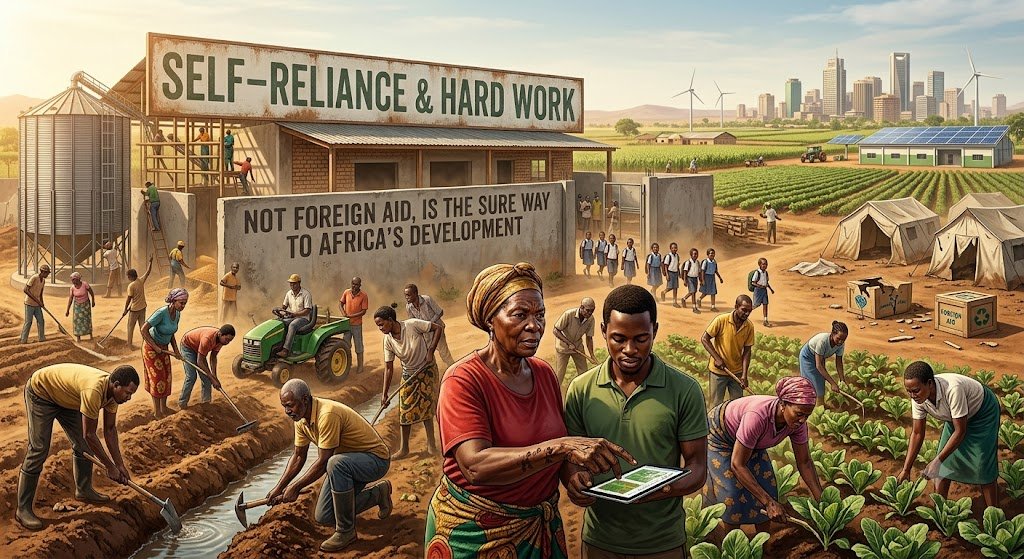
It is time for Africa to rethink its dependence on foreign aid and place greater emphasis on self-reliance, productivity, innovation, and hard work. The future of Africa will not be built in donor conferences or aid negotiations. It will be built by Africans themselves.
The Dignity of Self-Reliance
There is something fundamentally troubling about sovereign nations repeatedly going abroad to seek assistance from others. Political independence loses much of its meaning when economic survival depends largely on the generosity of foreign governments and institutions.
There is dignity in self-reliance. There is pride in producing what one consumes. There is strength in building institutions that can stand on their own feet without depending on external support. A continent blessed with abundant natural resources, fertile land, energetic youth, and entrepreneurial talent should not perpetually present itself as a recipient of charity.
The Problem with Foreign Aid
Foreign aid is often presented as an act of generosity. However, aid is rarely free of conditions. In many cases, aid comes with political, economic, or strategic strings attached.
Donor countries frequently use aid to advance their own interests. Aid packages may require recipient countries to purchase goods and services from donor nations, adopt certain economic policies, support particular diplomatic positions, or grant access to valuable resources and markets.
As a result, aid can sometimes benefit donors as much as—or even more than—the recipients.
Furthermore, aid can create a culture of dependency. Governments that expect external assistance may become less motivated to mobilize domestic resources, strengthen tax systems, or pursue difficult but necessary reforms. Instead of looking inward for solutions, they look outward for rescue.
Dependence on aid can also weaken accountability. Governments may become more responsive to donors than to their own citizens. When substantial portions of national budgets come from external sources, leaders may feel less pressure to deliver results to taxpayers.
This is not to suggest that all aid is harmful. Humanitarian assistance during natural disasters, disease outbreaks, wars, and other emergencies can save lives and reduce suffering. Technical cooperation and knowledge sharing can also play valuable roles. The problem arises when aid becomes a permanent development strategy rather than a temporary supplement.
A More Honest Look at Global Wealth
Throughout history, nations that achieved prosperity did so through a combination of factors, including hard work, innovation, industrialization, technological advancement, and effective institutions. However, it is equally important to acknowledge that many of today’s wealthy nations accumulated enormous wealth through colonial conquest, slavery, imperial domination, and the extraction of resources from Africa, Asia, the Caribbean, and Latin America. For centuries, colonial powers enriched themselves through the exploitation of colonized peoples, the appropriation of land, the extraction of gold, diamonds, timber, and other raw materials, and the use of forced and underpaid labor. Even after political independence, various forms of economic dependency and unequal trade relations have continued to transfer wealth from developing nations to richer countries. Nevertheless, Africa cannot build its future by dwelling solely on historical injustices. While the continent must recognize and challenge unfair global structures, its long-term development will depend primarily on the productive energies, creativity, entrepreneurship, and hard work of its own people.
Acknowledging the historical role of colonialism does not diminish the importance of self-reliance. Rather, it highlights why Africa must become economically stronger and less dependent on external powers. The ultimate response to centuries of exploitation is not perpetual dependence on aid, but the creation of vibrant economies capable of generating wealth, employment, and prosperity from within. Africa's greatest victory will come not from receiving assistance, but from building nations that no longer need it.
Africa's Greatest Resource Is Its People
One of the greatest misconceptions about Africa is that it is a poor continent. In reality, Africa is extraordinarily rich.
The continent possesses vast reserves of gold, diamonds, oil, natural gas, cobalt, manganese, bauxite, lithium, copper, timber, and countless other valuable resources. It has some of the world's most fertile agricultural land. It has abundant sunshine, rivers, and renewable energy potential.
Most importantly, Africa has people.
Africa is home to one of the youngest populations in the world. Millions of energetic, creative, and ambitious young men and women enter the workforce each year. If properly educated, trained, and empowered, this youthful population could become the driving force behind unprecedented economic growth.
The challenge is not a lack of resources. The challenge is how those resources are managed and utilized.
The Importance of Hard Work and Productivity
No society can prosper without hard work. Wealth is created through production, innovation, entrepreneurship, and enterprise.
Africa must cultivate a culture that rewards excellence, discipline, and productivity. Governments should create environments where businesses can thrive, farmers can increase yields, manufacturers can expand production, and entrepreneurs can innovate.
Investment in education should focus not only on producing graduates but also on developing practical skills. Technical and vocational training should receive greater attention. Young people should be encouraged to become creators of jobs rather than merely seekers of jobs.
Agriculture must be modernized. Africa imports billions of dollars' worth of food annually despite possessing vast arable land. Manufacturing must be expanded so that raw materials are processed locally rather than exported in their crude form. Technology and digital innovation should be embraced as engines of future growth.
Economic transformation will require sacrifice and sustained effort, but no nation has ever become prosperous without both.
A New African Mindset
The time has come for a new mindset across the continent.
African governments should prioritize domestic resource mobilization, good governance, transparency, industrialization, and value addition. Citizens should embrace entrepreneurship, innovation, and hard work. Educational institutions should nurture problem-solvers and creators. Leaders should focus less on securing aid and more on creating conditions for economic productivity.
Africa's future should not depend on donor generosity. It should depend on African initiative.
The continent that gave humanity some of its earliest civilizations possesses everything necessary to succeed in the twenty-first century. What is required is confidence, vision, discipline, and a commitment to self-reliance.
Foreign aid may offer temporary relief, but it cannot substitute for national effort. The road to genuine development runs through the farms, factories, classrooms, laboratories, and businesses of Africa itself.
The message for Africa is simple and timeless: self-reliance, hard work, not foreign aid, will lift up the continent.