Introduction
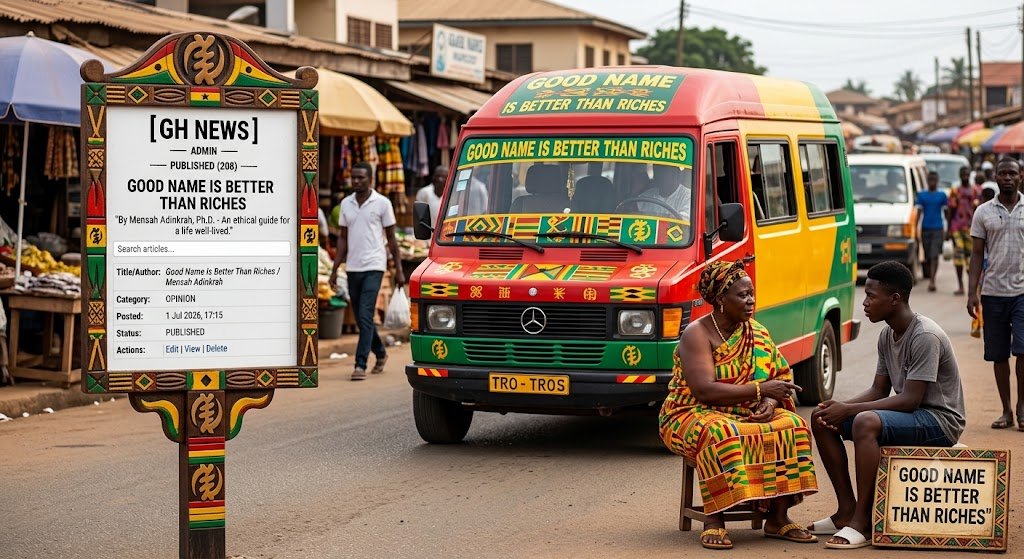
One of the most profound pieces of wisdom in Ghanaian culture is the saying: "Good name is better than riches." The Akan version, "Din Pa Yɛ Sen Ahonya," conveys the same timeless message. It reminds us that a person's reputation, integrity, and character are more valuable than money, property, or material possessions.
For many years, this proverb has appeared as an inscription on commercial vehicles traveling on Ghanaian roads. It has also been displayed on signboards advertising businesses and has been quoted by parents, teachers, religious leaders, and community elders. The message is simple but powerful: it is better to be respected and trusted than to be wealthy through dishonest means.
Unfortunately, we live in a time when many people appear to place greater value on wealth than on character. The pressure to become rich quickly has tempted some individuals to adopt unethical, deviant, and even criminal methods of acquiring money. In the process, they may accumulate wealth, but they often lose something far more valuable—their good name.
Wealth Without Honor
There is nothing wrong with being wealthy. Indeed, hard work, innovation, and entrepreneurship should be rewarded. The problem arises when people pursue riches without regard for honesty, integrity, and the law.
A person may acquire a large house, luxury vehicles, and impressive bank accounts, but if society knows that the wealth was obtained through fraud, corruption, theft, or deception, such riches bring little honor. The individual may be rich, but he or she is not respected.
A good name takes years to build but can be destroyed in a matter of minutes.
The Teacher Who Betrays Public Trust
Teachers occupy a special place in society. Parents entrust them with the education and development of their children. As role models, teachers are expected to demonstrate honesty, discipline, and integrity.
Imagine a teacher who secretly demands money from students before awarding them good grades. Another teacher leaks examination questions to students in exchange for cash. Yet another operates a "pay-to-pass" scheme in which students who offer gifts or money receive favorable treatment.
At first, such a teacher may appear successful. He may build a house, purchase a vehicle, and enjoy a comfortable lifestyle. However, if his misconduct is exposed, his reputation will be ruined. Students, parents, colleagues, and the wider community will no longer respect him. He may lose his job, face disciplinary action, or even be prosecuted.
The money gained through dishonesty may disappear, but the stain on his reputation may remain for the rest of his life.
A teacher who lives modestly but honestly earns far greater respect than one who becomes wealthy through corruption.
The Farmer Who Cuts Corners
Farmers play a critical role in Ghana's economy by producing food for the nation. Most farmers work diligently and honestly. However, some may be tempted to use illegal or unethical methods to increase profits.
Consider a farmer who applies banned chemicals to vegetables shortly before harvest to improve appearance and increase yields. Another may illegally clear protected forest land to expand cultivation. Yet another may knowingly sell diseased livestock to unsuspecting buyers.
Initially, such practices may generate higher income. However, the consequences can be severe. Consumers may become ill. Environmental damage may occur. Regulatory authorities may impose fines or other sanctions.
Once the public learns that a farmer has endangered people's health or violated environmental regulations for financial gain, trust is lost. Buyers may avoid the farmer's products, and the farmer's reputation may suffer lasting damage.
The honest farmer who follows proper agricultural practices may earn less in the short term but preserves something priceless: a good name.
The Trader Who Cheats Customers
The marketplace depends on trust. Customers return to businesses that treat them fairly and honestly.
Imagine a trader who manipulates weighing scales so that customers receive less than what they pay for. Another trader may mix inferior goods with higher-quality products while charging premium prices. A retailer may knowingly sell expired products after changing the labels or concealing expiration dates.
Such practices may produce quick profits, but they rarely remain hidden forever. Customers talk to one another. News spreads rapidly through communities and social media. Once people discover that a trader is dishonest, they take their business elsewhere.
In many Ghanaian communities, a trader's reputation is one of his or her greatest assets. Customers often prefer to buy from individuals whom they know and trust. A reputation for honesty attracts customers, while a reputation for deceit drives them away.
The trader who earns a modest profit through fair dealing often enjoys greater long-term success than the one who pursues quick gains through dishonesty.
Lessons from Public Life
The same principle applies to public officials, business executives, religious leaders, and politicians.
Imagine a politician who secures election through lies, deception, or vote-buying. Once the truth emerges, public confidence evaporates. The individual may retain wealth or influence for a time, but respect is lost.
Similarly, consider a public official who accumulates wealth through corruption. When investigations reveal the source of the riches, the person's achievements become overshadowed by scandal. Instead of being remembered for service and leadership, the individual becomes known for dishonesty.
History teaches us that wealth acquired through questionable means often brings disgrace rather than honor.
Why a Good Name Matters
A good name opens doors that money cannot open. It inspires trust, creates opportunities, and strengthens relationships. Employers seek trustworthy workers. Customers patronize trustworthy businesses. Communities respect trustworthy leaders.
When people hear your name, what do they think of? Do they associate it with honesty, fairness, and integrity, or with deception and wrongdoing?
That question is more important than the size of one's bank account.
Final Thoughts
The Akan proverb "Din Pa Yɛ Sen Ahonya"—Good Name Is Better Than Riches— remains as relevant today as it was generations ago. Wealth can be lost through economic hardship, theft, or misfortune. Property can be destroyed. Money can disappear. But a good reputation, once earned and carefully protected, becomes a lasting legacy.
As we pursue success, let us remember that how we acquire wealth matters just as much as the wealth itself. Whether we are teachers, farmers, traders, politicians, students, or professionals, we should strive to earn our livelihoods through honest and honorable means.
In the end, it is not merely what we possess that defines us. It is the kind of name we leave behind.