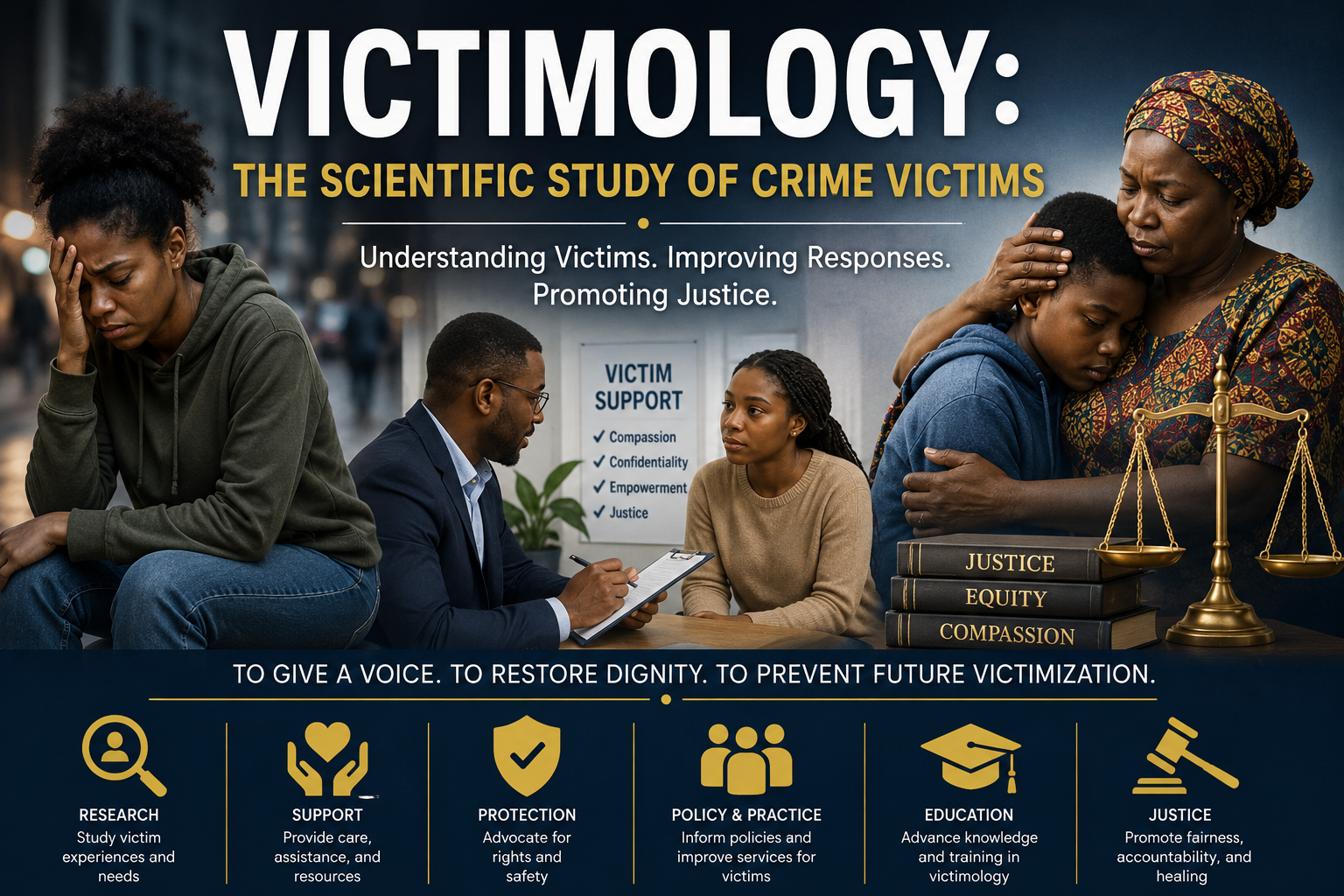
The Neglect of Crime Victims
For many decades, the study of crime was largely concerned with offenders. Criminologists focused their attention on criminals, criminal behavior, and the causes of crime. Researchers sought to understand why people committed crimes, what social and economic factors contributed to criminal behavior, and what types of individuals were more likely to engage in unlawful activities. While these studies generated valuable knowledge about crime and criminals, they often overlooked a very important group of people—the victims of crime.
The neglect of crime victims led to the emergence of a new field of study known as victimology. Victimology is the scientific study of crime victims, their experiences, their relationships with offenders, and the role they play in the criminal justice system. Today, victimology has become one of the most important branches of criminology because it helps society understand the suffering and needs of victims and promotes policies that protect and support them.
Victimology developed rapidly during the second half of the twentieth century. Scholars recognized that crime does not affect only offenders; it also has profound consequences for victims, their families, and communities. Every act of theft, assault, robbery, rape, fraud, or homicide leaves behind victims whose lives may be permanently altered. Understanding these effects is a central concern of victimologists.
Primary Victims of Crime
Victimologists primarily focus on what are known as primary victims. A primary victim is a person who directly suffers the consequences of a crime. For example, a woman who is robbed on her way home from work is a primary victim. A child who is physically abused by a caregiver is a primary victim. Likewise, a person who is assaulted, defrauded, kidnapped, or murdered is a primary victim of crime.
In Ghana, examples of primary victims are unfortunately numerous. The trader who loses her earnings to an armed robber, the elderly pensioner who is swindled by fraudsters, the student who is sexually assaulted, and the motorist who is attacked by highway robbers are all primary victims. Their losses may be financial, physical, emotional, or psychological. In many cases, victims continue to suffer long after the crime has occurred.
Secondary Victims and Their Suffering
However, victimologists do not limit their attention to primary victims. They also study secondary victims. Secondary victims are individuals who suffer indirectly because of their relationship with the primary victim. These may include spouses, children, parents, siblings, friends, neighbors, co-workers, and other associates of the primary victim.
Consider the case of a murder victim. The deceased person is the primary victim, but the consequences of the crime extend far beyond the individual who was killed. The victim's spouse may lose emotional and financial support. Children may lose a parent. Parents may suffer intense grief and psychological trauma. Friends and neighbors may experience fear, sadness, and insecurity. These individuals are secondary victims because they suffer as a result of the crime committed against the primary victim.
The impact of crime on secondary victims can be severe. Family members of homicide victims often experience depression, anxiety, sleep disturbances, and economic hardship. In Ghana, where family ties are particularly strong, the death or victimization of one individual can profoundly affect an entire extended family. The emotional pain may last for years and may never completely disappear.
Victim Precipitation: A Controversial Concept
One important area of victimological research concerns victim precipitation. Victim precipitation refers to situations in which a victim may contribute, either knowingly or unknowingly, to the events that lead to the crime. This is one of the most controversial topics in victimology because it is often misunderstood.
Victim precipitation does not mean that the victim is responsible for the crime. Responsibility for criminal acts always rests with the offender. However, victimologists recognize that in some situations, the behavior of victims may influence the circumstances under which crimes occur.
One of the earliest scholars to examine this issue was the criminologist Marvin Wolfgang. Based on his study of homicide cases in Philadelphia, Wolfgang coined the term victim-precipitated homicide. He found that in some homicide incidents, the victim was the first person to use physical force or display a weapon before being killed. His findings suggested that certain victims played a role in initiating the chain of events that resulted in their deaths.
Similarly, Menachem Amir introduced the concept of victim-precipitated rape based on his research in Philadelphia. His work generated considerable controversy because many people feared that it might encourage victim blaming. Modern victimologists therefore approach the concept of victim precipitation with great caution. They emphasize that understanding the circumstances surrounding a crime should never be interpreted as excusing or justifying criminal behavior.
Vulnerability to Victimization
Victimologists also study the characteristics that may make certain individuals more vulnerable to victimization. Research has shown that age, gender, occupation, lifestyle, and place of residence can influence the likelihood of becoming a victim of crime.
For example, children are particularly vulnerable to physical abuse, sexual abuse, neglect, trafficking, and exploitation. Elderly persons may be vulnerable to fraud, financial exploitation, and physical abuse. Women face heightened risks of sexual violence and intimate partner violence. Persons with disabilities may also be especially vulnerable because of their dependence on caregivers or their limited ability to protect themselves.
In Ghana, reports of child abuse, domestic violence, cyber fraud, human trafficking, and attacks on elderly persons accused of witchcraft highlight the importance of victimological research. By studying these forms of victimization, researchers can identify risk factors and develop strategies to protect vulnerable populations.
Victimology and Criminal Justice Reform
Victimology has also contributed significantly to criminal justice reforms around the world. In the past, criminal justice systems often focused almost exclusively on offenders. Victims were treated merely as witnesses and were given little opportunity to express their experiences or concerns. Many victims felt ignored and marginalized by the justice process.
As a result of victimological research and advocacy, greater attention is now being paid to the rights and welfare of crime victims. Many countries have established victim assistance programs, compensation schemes, counseling services, and crisis intervention centers. Police officers, prosecutors, and judges are increasingly encouraged to treat victims with dignity, respect, and compassion.
The Importance of Victim-Impact Statements
One particularly important development is the use of victim-impact statements. A victim-impact statement is a formal statement made by a victim or a victim's family describing how a crime has affected their lives. The statement may discuss physical injuries, emotional suffering, financial losses, and other consequences of the offense.
In some jurisdictions, judges are required to consider victim-impact statements during sentencing. These statements allow victims to have a voice in the criminal justice process and help courts understand the full human consequences of criminal behavior. For families of homicide victims, the opportunity to speak about their loss can provide a sense of participation and recognition.
The Way Forward for Ghana
Ghana has made important strides in protecting victims through legislation such as the Domestic Violence Act and the Human Trafficking Act. However, much remains to be done. Many victims continue to face barriers when seeking justice. Some are reluctant to report crimes because of fear, stigma, lack of confidence in authorities, or concerns about retaliation. Others lack access to counseling and support services.
Victimology reminds us that crime is not merely a violation of law; it is also a violation of human lives. Every crime creates suffering that extends beyond statistics and police reports. Behind every criminal act is a victim whose life has been disrupted and whose dignity has been challenged.
As Ghana continues to develop its criminal justice system, policymakers, law enforcement officials, social workers, religious leaders, and community members must pay greater attention to the needs of victims. Crime prevention remains important, but so too is victim support. A compassionate and just society is one that not only punishes offenders but also recognizes, assists, and empowers victims.
Conclusion
Victimology has taught us an important lesson: crime cannot be fully understood unless we listen to the voices of those who suffer its consequences. By studying victims and addressing their needs, we move closer to creating a safer, fairer, and more humane society for all.
Latest updates
Refreshes automaticallyThis live blog has started. Updates will appear here as they come in.