"Woankasa wo tiri ho a, yɛyi wo ayibone" — If you don’t say how you want your hair styled, the hairstylist will give you a bad haircut.
Proverbs as a Pillar of Akan Culture
One of the most fascinating aspects of Akan culture is the extensive use of proverbs in everyday communication. Whether in family discussions, community gatherings, traditional courts, funerals, political speeches, or chieftaincy ceremonies, proverbs occupy a central place in Akan social life. They are not merely decorative expressions; they are important vehicles for transmitting wisdom, teaching moral lessons, preserving cultural values, and communicating ideas with precision and elegance.
Proverb Use in Akan Social Life
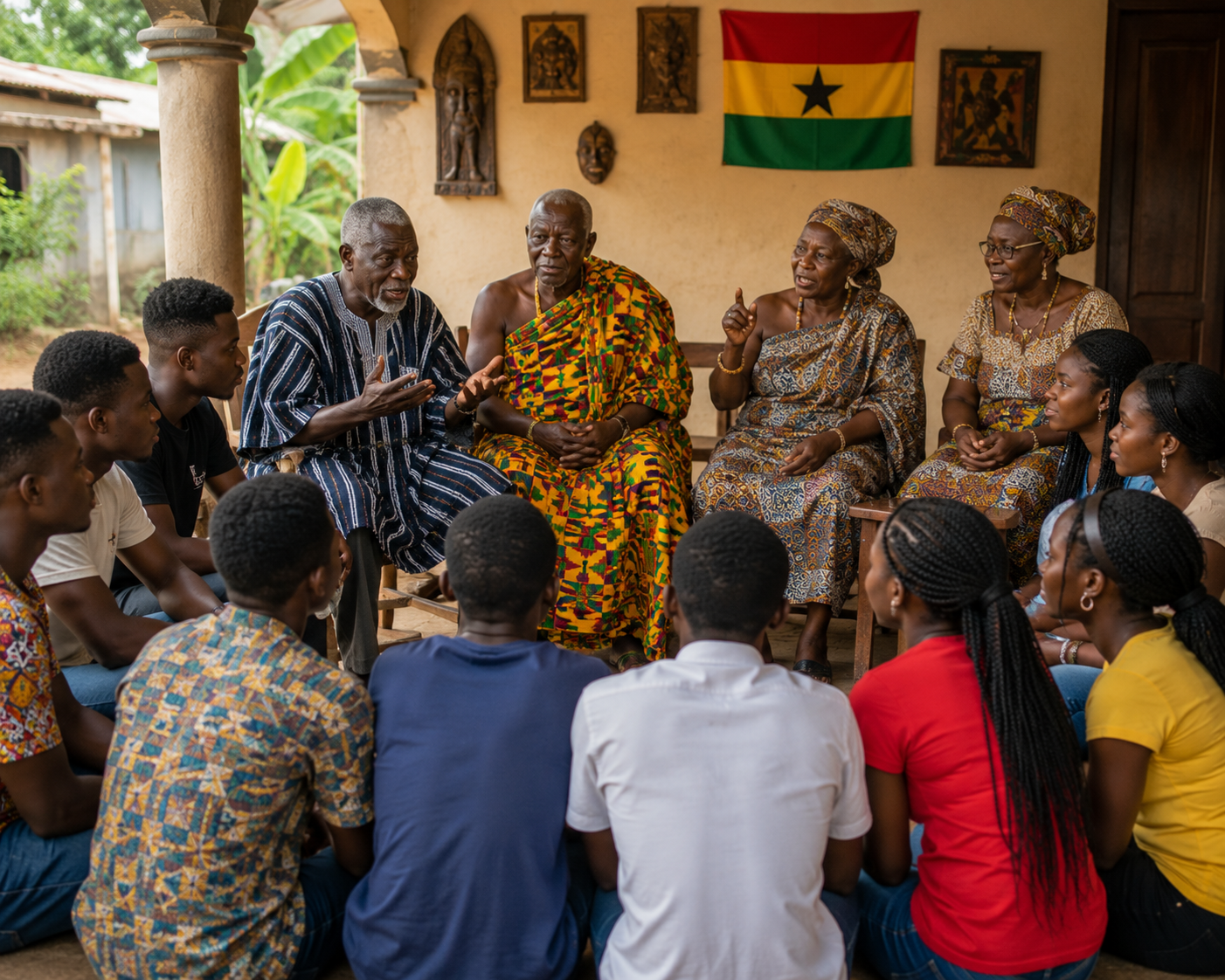
Attend a traditional council meeting, a family gathering, a funeral, or a community dispute among the Akans, and one thing quickly becomes apparent: people do not merely speak; they speak in proverbs. An elder seeking to offer advice, a chief addressing his subjects through an Okyeame, or a parent correcting a child will often draw upon a proverb to make a point. In many instances, a well-chosen proverb carries more weight than a lengthy explanation. Among the Akans, wisdom is not measured only by what one knows but also by one's ability to express that knowledge through appropriate proverbial language.
The extensive use of proverbs is one of the most distinctive features of Akan culture. Proverbs are woven into everyday communication and are heard in homes, marketplaces, churches, schools, traditional courts, political platforms, and chieftaincy ceremonies. Far from being mere ornaments of speech, they serve as powerful tools for teaching moral lessons, preserving cultural values, settling disputes, transmitting ancestral wisdom, and communicating ideas with precision and elegance.
Among the Akan people of Ghana, a proverb is known as ɛbɛ (plural: mmɛ). Proverbs are generally believed to have been handed down by ancestors and elders over many generations. They represent the accumulated wisdom, experiences, observations, and philosophies of Akan society. As a result, proverbs command great respect and continue to occupy a central place in Akan social and cultural life.
Proverbs in Akan Society
Among the Akan people of Ghana, a proverb is known as ɛbɛ (plural: mmɛ). Proverbs are generally believed to have been handed down by ancestors and elders over many generations. They represent the accumulated wisdom, experiences, observations, and philosophies of the society. As a result, proverbs command great respect and continue to play a significant role in Akan communication.
Proverbs and Social Prestige
Traditionally, the ability to understand and interpret proverbs is regarded as a sign of intelligence, maturity, and cultural competence. In many Akan communities, an individual who can accurately explain the meaning of proverbs is admired and respected. Likewise, those who can skillfully incorporate proverbs into their speech are often viewed as knowledgeable, wise, and eloquent.
Indeed, among the Akans, proverb use has long been associated with social prestige. Elders are especially expected to possess a rich repertoire of proverbs and to employ them appropriately when addressing important matters. A speaker who peppers his or her speech with relevant proverbs is generally considered persuasive and culturally grounded.
Proverbs in Chieftaincy and Traditional Leadership
The importance of proverbs is perhaps most visible within the institution of chieftaincy. Chiefs rarely speak directly in public on ceremonial occasions. Instead, their messages are often communicated through the Okyeame or linguist. The Okyeame serves as the chief's spokesperson, interpreter, and advisor. One of the most important qualifications for becoming an Okyeame is an extensive familiarity with Akan proverbs and the ability to deploy them effectively.
When chiefs communicate through their linguists, messages are frequently couched in proverbial language. The use of proverbs lends authority, dignity, and cultural authenticity to the communication. A skilled Okyeame can employ an appropriate proverb to clarify a message, resolve a dispute, advise a subordinate, or praise a distinguished guest. In many cases, the proverb itself conveys the message more powerfully than a lengthy explanation could.
The Rise of Proverb Competitions
The continuing popularity of proverbs among the Akans is reflected in the emergence of proverb competitions. In recent years, various commercial radio and television stations have organized abɛbuo competitions in which contestants compete by reciting, interpreting, and explaining Akan proverbs. Such competitions attract considerable public interest and serve as an important means of preserving indigenous knowledge.
Participants are often required to complete proverbs, explain their meanings, identify situations in which they may be used, or respond to a proverb with another proverb carrying a related meaning. These contests not only entertain audiences but also educate younger generations about an important aspect of Akan cultural heritage.
The Many Functions of Proverbs
The uses of proverbs in Akan society are numerous. One of their most important functions is their ability to summarize complex ideas in a concise manner. A proverb can capture in a few words what might otherwise require a lengthy explanation. What would have taken several minutes to describe can often be communicated through a single proverb. This economy of expression makes proverbs highly effective tools of communication.
Proverbs are also useful because they enable speakers to discuss sensitive issues indirectly. In many social situations, direct criticism or blunt speech may be considered disrespectful or offensive. A proverb allows a speaker to convey a difficult message without embarrassing the listener. Through the use of metaphor and symbolism, proverbs soften criticism while still communicating the intended lesson.
For example, a person may use a proverb to advise someone who is behaving recklessly, to caution a friend against excessive pride, or to criticize a leader's actions without resorting to direct confrontation. In this way, proverbs promote social harmony while preserving the dignity of those involved.
Proverbs as a Tool of Effective Communication
Another important function of proverbs is their ability to enliven speech. Public addresses, sermons, political speeches, family meetings, and traditional ceremonies often become more engaging when enriched with appropriate proverbs. Audiences generally pay closer attention to speakers who employ proverbs effectively because such expressions add colour, depth, and cultural resonance to communication.
Proverbs also serve as educational tools. For generations, Akan parents, grandparents, teachers, and community elders have used proverbs to teach children about honesty, hard work, respect, humility, patience, and perseverance. Many moral lessons that might otherwise be forgotten are remembered because they are encapsulated in memorable proverbial expressions.
**Preserving Akan Proverbs Through Literature ** Recognizing the cultural importance of proverbs, several scholars and writers have devoted considerable effort to collecting and preserving them. As a result, a number of proverb anthologies have been published over the years. One of the most notable examples is Bu Me Bɛ: Proverbs of the Akans, authored by Peggy Appiah, Kwame Anthony Appiah, and Ivor Agyeman-Duah. The volume contains approximately 7,015 Akan proverbs together with their English translations and interpretations. It remains one of the most comprehensive collections of Akan proverbs ever assembled.
The publication of such works is particularly important at a time when globalization, urbanization, and changing lifestyles are transforming patterns of communication. While younger generations increasingly communicate through social media and digital platforms, proverb collections help ensure that traditional wisdom is preserved for future generations.
Keeping the Tradition Alive
Despite rapid social change, proverbs continue to occupy a cherished place in Akan culture. They remain powerful instruments for teaching, advising, entertaining, persuading, and preserving collective memory. Their continued use in homes, schools, churches, traditional councils, radio programmes, and public discourse demonstrates their enduring relevance.
As Ghana modernizes, there is a need to encourage younger generations to learn, appreciate, and use proverbs. These expressions are more than linguistic ornaments; they are repositories of history, philosophy, morality, and indigenous knowledge. To lose them would be to lose an important part of Akan identity and cultural heritage.
The Akan proverb tradition therefore deserves not only preservation but also celebration. It remains one of the richest and most enduring treasures of Ghanaian culture.
Latest updates
Refreshes automaticallyThis live blog has started. Updates will appear here as they come in.