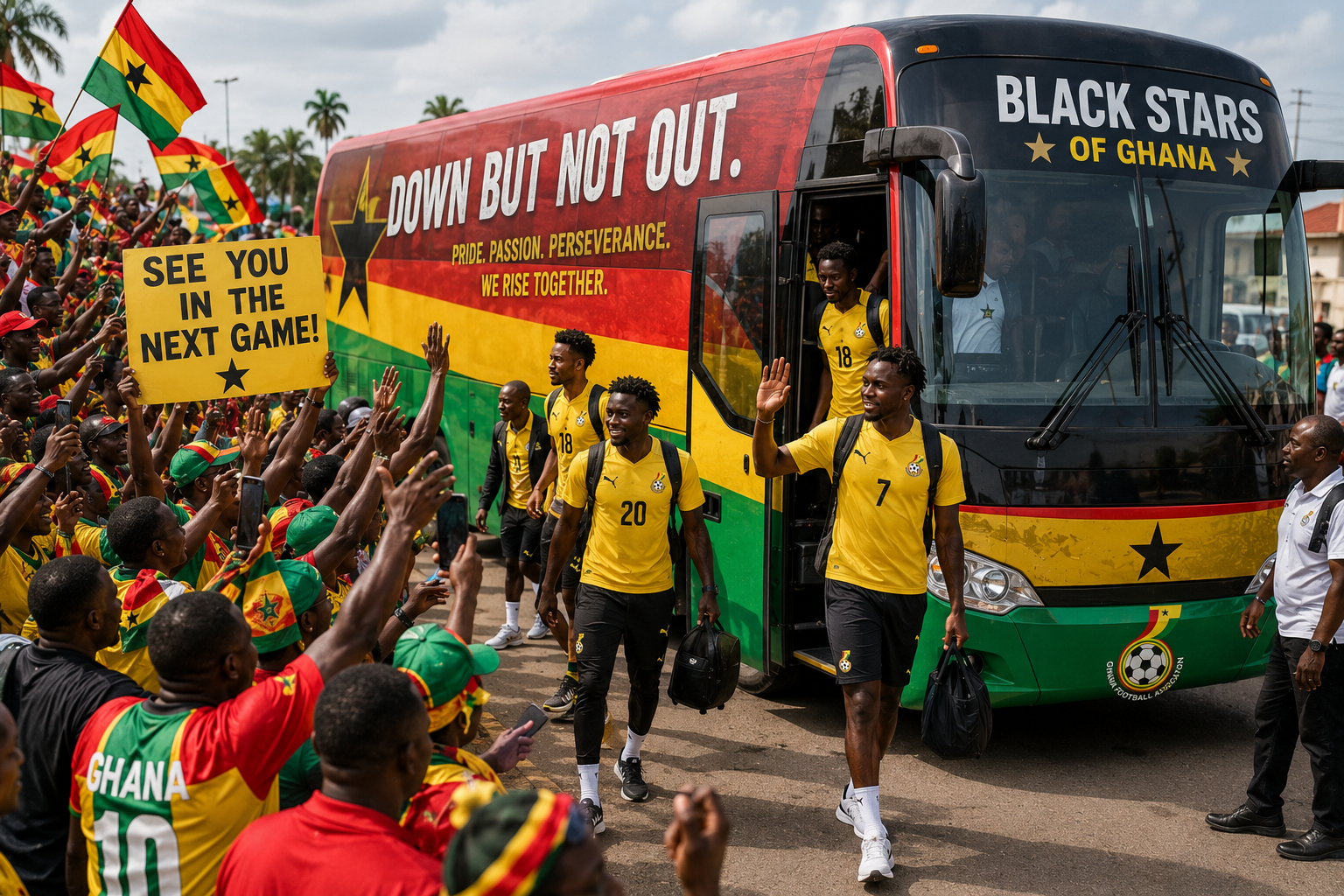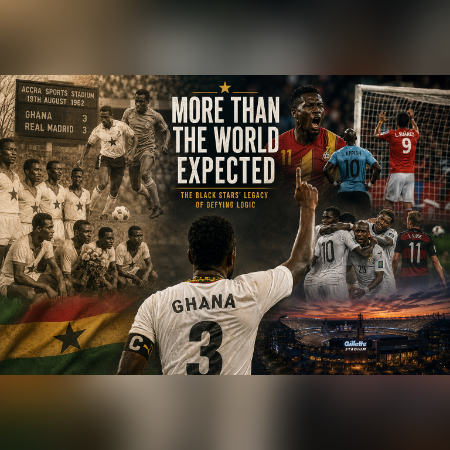
The clock at Soccer City in Johannesburg had barely ticked past the 120th minute when an entire continent seemed to stop breathing.
Luis Suárez was already walking off the field, sent off for deliberately handling Dominic Adiyiah’s goal-bound header on the line. Ghana had been awarded a penalty. The Black Stars stood one kick away from becoming the first African nation to reach a FIFA World Cup semi-final. Across Accra, Kumasi, Tamale, Lagos, Nairobi, Johannesburg, and Dakar, millions leaned toward television screens. History was waiting.
Then Asamoah Gyan’s shot crashed against the crossbar.
The sound echoed far beyond South Africa. It reverberated through decades of African football dreams.
When Ghana eventually lost the penalty shootout to Uruguay, the image that remained was not merely one of heartbreak. It was something more profound. In that moment, Ghana had become Africa’s last hope—and for a few unforgettable hours, the Black Stars carried the ambitions of an entire continent.
As the countdown to the 2026 FIFA World Cup continues, that responsibility remains central to Ghana’s identity. No African nation has embodied the continent’s World Cup aspirations more consistently, more dramatically, or more painfully than Ghana.
The Weight of a Continent
African football’s relationship with the World Cup has always been shaped by the pursuit of legitimacy.
For decades, African nations were granted only limited places at the tournament despite producing extraordinary talent. The achievements of players such as Abedi Pele, Roger Milla, Rabah Madjer, and George Weah demonstrated Africa’s quality, but the continent struggled to convert individual brilliance into sustained World Cup success.
The breakthrough came in stages.
Cameroon shocked the world in 1990 by reaching the quarter-finals. Roger Milla danced beside corner flags and inspired a generation. Senegal stunned defending champions France in 2002 and reached the last eight. Yet both campaigns ended before the semi-finals.
Then came Ghana.
Unlike many African teams whose World Cup appearances arrived in isolated bursts, Ghana built a reputation for consistency. The Black Stars qualified for their first World Cup in 2006 and immediately reached the Round of 16. Four years later, they went further than any African team at the tournament.
The significance of that achievement cannot be overstated.
South Africa 2010 was Africa’s World Cup. It was the first time the tournament had been hosted on African soil. Expectations were immense. One by one, African teams fell away. South Africa, Nigeria, Algeria, Cameroon, and Ivory Coast were eliminated.
Only Ghana remained.
Suddenly, the Black Stars were no longer representing merely a nation of roughly 25 million people. They carried the hopes of more than a billion Africans.
That is a burden few teams in football history have ever experienced.
The Generation That Carried Africa
The remarkable aspect of Ghana’s 2010 run was not simply the results. It was the character of the squad.
Richard Kingson brought resilience in goal. John Mensah marshalled the defence with authority. Sulley Muntari combined power with unpredictability. Kevin-Prince Boateng added edge and confidence. André Ayew provided youthful energy.
And then there was Asamoah Gyan.
For years, Gyan was misunderstood outside Africa. Critics focused on missed chances or inconsistent club careers. Yet for Ghana, he represented something different: a player willing to shoulder impossible expectations.
His winning goal against the United States in extra time sent Ghana into the quarter-finals and cemented his status as a national icon. Even after the devastating miss against Uruguay, Gyan’s contribution to Ghanaian football remained immense.
The tragedy of 2010 is that history often remembers only the penalty.
What it should remember is that Ghana became the standard-bearer for African football. The Black Stars demonstrated tactical discipline, mental toughness, and a capacity to compete with elite opponents deep into the tournament.
That legacy still matters.
Why Ghana Became Africa’s Team
Some nations become neutral favourites because of style. Others because of circumstance.
Ghana became Africa’s team because of credibility.
Unlike countries whose World Cup success rested on one extraordinary tournament, Ghana established a pattern. Between 2006 and 2014, the Black Stars reached the knockout rounds twice in three appearances.
The squad also reflected the realities of modern African football. Players emerged from local academies, moved through European leagues, and returned to international duty carrying diverse footballing influences.
There was sophistication to Ghana’s game.
The Black Stars could defend compactly, attack directly, or control possession when required. They possessed physicality without sacrificing technical quality.
Most importantly, they carried themselves with belief.
African teams have often entered World Cups burdened by narratives about underachievement. Ghana rarely appeared intimidated. Whether facing Italy, Germany, the United States, Portugal, or Uruguay, the Black Stars competed as equals.
That mentality transformed perceptions.
The Painful Years That Followed
Yet football history is rarely linear.
After the highs of 2010 came turbulence.
The 2014 World Cup became overshadowed by disputes over player bonuses and administrative dysfunction. Ghana exited in the group stage despite possessing enormous talent. The image of cash being flown into Brazil to resolve payment disagreements became symbolic of deeper structural problems.
Subsequent years brought inconsistency.
The Black Stars remained competitive but struggled to recapture the magic of their golden era. Qualification disappointments, managerial changes, and uneven performances created frustration among supporters accustomed to seeing Ghana challenge the continent’s elite.
Meanwhile, Morocco reached the semi-finals in 2022, becoming the first African nation to achieve what Ghana had once come so close to accomplishing.
For some observers, Morocco replaced Ghana as Africa’s great World Cup story.
That interpretation misses the point.
Morocco’s achievement did not erase Ghana’s significance. If anything, it reinforced it. The path Morocco travelled had been cleared by previous generations—by Cameroon, Senegal, and especially Ghana.
The Black Stars showed Africa that a semi-final was not fantasy. It was attainable.
What 2026 Means
Every World Cup creates new possibilities. The expanded 48-team format in 2026 will give African nations more opportunities than ever before.
For Ghana, this tournament represents more than qualification.
It represents renewal.
A new generation is emerging. Players raised on stories of 2006 and 2010 now have the chance to create their own chapter. They grew up watching Gyan, Ayew, Muntari, Essien, and Mensah. They understand what the Black Stars symbolize.
That symbolism matters because Ghana’s World Cup history is not defined solely by results.
It is defined by moments.
The victory over the Czech Republic in 2006. Gyan’s extra-time winner against the United States in 2010. The dramatic triumph over South Korea in 2022. Even the heartbreak against Uruguay remains etched into football memory.
The Black Stars have consistently produced matches that transcend sport.
As 2026 approaches, Ghana’s challenge is to convert nostalgia into momentum.
History can inspire, but it cannot score goals.
The next generation must write its own story.
Pundit’s Verdict
The phrase “Africa’s last hope” can sound romantic, even burdensome. Yet no African nation has worn that label more naturally than Ghana.
The Black Stars earned it through courage, consistency, and an ability to rise when the stakes were highest. Their greatest World Cup moments were never merely Ghanaian moments; they belonged to the continent.
That is why the memory of Johannesburg still resonates sixteen years later.
Not because Ghana lost.
Because, for one extraordinary night, Ghana convinced Africa that the impossible was within reach.
As the road to 2026 continues, that remains the Black Stars’ greatest gift to African football. They transformed expectation into belief.
And belief, more than tactics or talent, is what changes history.
If Ghana can rediscover that spirit in North America, they may once again become Africa’s last hope.
The difference this time is that they will travel knowing the dream is no longer theoretical. It has already been tested, carried, and nearly fulfilled by the Black Stars themselves.