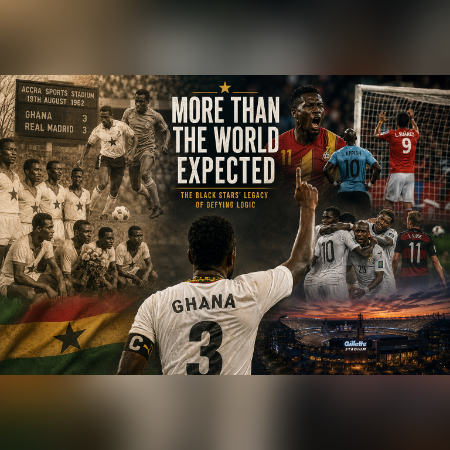
The smell of dust and roasted groundnuts drifted across the terraces as thirty thousand people squeezed into the Accra Sports Stadium on a humid August afternoon in 1962. Somewhere beneath the noise, beneath the brass bands and the restless anticipation of a young nation still discovering itself, stood the greatest club team on earth.
Real Madrid had arrived carrying the weight of football royalty.
Five consecutive European Cups. Intercontinental champions. The team of Alfredo Di Stéfano, Ferenc Puskás and Francisco Gento. They were not merely successful; they were the standard against which the rest of the footballing world measured itself. There was no obvious reason why a recently independent African nation should belong on the same pitch.
Yet Ghana had never been particularly interested in obvious reasons.
By the end of the afternoon, the scoreboard read 3-3.
Twice Ghana led. Twice Real Madrid fought back. Puskás equalized. Zoco equalized. Edward Acquah scored twice for the hosts. Aggrey Fynn added another. The visitors left with a draw. The crowd left with something larger.
For perhaps the first time, football's established powers were forced to reconsider what they thought they knew about African football.
Among those who appeared that day was a young substitute named Osei Kofi. His first touch led directly to a goal. Years later, Gordon Banks — the England goalkeeper whose save from Pelé would become one of the most celebrated moments in World Cup history — would speak of Osei Kofi with the sort of reverence usually reserved for European legends. Banks remembered him putting four goals past him and considered him the equal of many of the great players he had encountered across the continent.
The world was only beginning to learn his name.
The following year Ghana won the Africa Cup of Nations.
The year after that, they won it again.
The world was not ready.
It never is.
Four years later, Ghana made another statement, one that never appeared on a scoreboard.
In 1966, they were reigning African champions. They should have been preparing for the World Cup in England. Instead, they joined the African boycott of the tournament in protest against FIFA's allocation of a single qualifying place for an entire continent.
It is easy, decades later, to view that decision as an administrative dispute.
It was not.
It was an act of self-definition.
A declaration that participation alone was not enough. A refusal to accept that African football should be treated as an afterthought in a game it helped enrich. It required sacrifice. It required certainty. Above all, it required pride.
The kind of pride that says we know who we are, even when you do not.
Long before Zaire(DR Congo) could be seen by the world, the Black Stars had planted it's Sub-saharan brothers firmly in dignity and pride.
It followed them all the way to Johannesburg.
By the evening of July 2, 2010, eighty-four thousand and seventeen people had filled Soccer City. The sound was constant, rising and falling like an ocean. This was the first World Cup ever held on African soil. One by one, every African team had fallen away.
Only Ghana remained.
A continent of fifty-four nations had found itself compressed into eleven players.
The burden should have been impossible.
Instead, Ghana carried it with grace.
Deep into first-half stoppage time, Sulley Muntari collected possession and struck from nearly forty yards. The ball travelled through the Johannesburg night with astonishing purpose, swerving beyond Fernando Muslera and into the net.
For a few seconds, the impossible felt close enough to touch.
Uruguay recovered through Diego Forlán's curling equalizer, but Ghana never stopped advancing. Asamoah Gyan attempted ten shots that night, more than any player on the pitch. Every attack felt like an argument. Every run felt like a challenge to history itself.
Then came the final minute of extra time.
A free kick drifted into the area.
A flick.
Confusion.
Stephen Appiah's effort was cleared from the line.
The ball stayed alive.
Dominic Adiyiah rose and headed towards an open goal.
And Luis Suárez reached up with both hands.
Football possesses language for most things.
Goals.
Saves.
Tackles.
Misses.
This was something else.
A deliberate act of prevention. A handball so blatant that it seemed to belong to a different sport entirely.
The referee did exactly what the laws demanded.
Red card.
Penalty.
Justice, supposedly.
But justice and fairness are not always the same thing.
Gyan stepped forward. He had already scored from the spot against Serbia and Australia. He was the tournament's leading scorer. The moment belonged to him.
The strike crashed against the crossbar.
Not the goalkeeper.
Not a defender.
The crossbar.
As Suárez celebrated from the tunnel and Gyan sank to his knees, the world reached for the language of tragedy.
But Ghana were not beaten that night.
They were stopped.
The laws of football had identified the crime.
They simply had no punishment severe enough to match it.
And still, what survives from that evening is not bitterness.
It is dignity.
The memory of a team that stood inches from becoming the first African nation to reach a World Cup semi-final and never looked overwhelmed by the occasion.
The crossbar moved.
Ghana did not.
Four years later came Fortaleza.
If Johannesburg represented the weight of expectation, Fortaleza represented the weight of chaos.
Hours before kickoff against Germany, two of Ghana's most influential players, Sulley Muntari and Kevin-Prince Boateng, had been suspended following a confrontation with team officials. Bonus disputes had spilled into public view. The camp appeared fractured.
Germany, meanwhile, had dismantled Portugal 4-0 only days earlier. They looked every inch a future champion.
They would become one.
But not before Ghana left their mark.
Mario Götze opened the scoring early in the second half and the expected script appeared ready to unfold.
Then Harrison Afful delivered a cross.
André Ayew rose above two German defenders and powered a header beyond Manuel Neuer.
Three minutes later, Muntari intercepted Philipp Lahm in midfield and slipped a pass through the channel. Asamoah Gyan accelerated onto it and flicked the ball beyond Neuer.
For a moment, the scoreboard showed something extraordinary.
Germany 1.
Ghana 2.
At a World Cup.
Against the team that would lift the trophy.
Germany required Miroslav Klose, veteran substitute and future record holder, to rescue them. His equalizer secured a 2-2 draw.
The result entered the record books.
The context rarely does.
Of all thirty-two teams at the 2014 World Cup, Ghana were the only side that did not lose to Germany.
Germany won the tournament.
Ghana drew with them.
That, too, belongs in the evidence file.
Which is why tonight feels familiar.
Foxborough.
Another powerful opponent.
Another occasion on which every model, projection and probability chart points confidently in one direction.
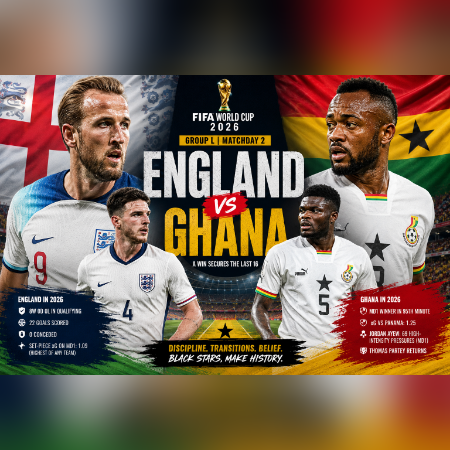
England arrive as favourites. The numbers insist upon it. A commanding victory over Croatia. Harry Kane already scoring. Set-piece routines polished to a dangerous shine. Simulations assigning them overwhelming probability.
The analytics have spoken.
The analytics have always spoken.
And somehow, throughout the history of the Black Stars, Ghana have always managed to answer back.
Thomas Partey is thirty-three now, old enough to understand the weight of these occasions and experienced enough to shape them. Jordan Ayew wears the accumulated memory of a football family whose roots run deep into the national shirt. Antoine Semenyo, Kamaldeen Sulemana and Ernest Nuamah belong to a generation that grew up watching Gyan's penalty strike the crossbar.
They inherited that image.
Not as a wound.
As a dare.
Because this is the thread running through every chapter of Ghanaian football history.
Not trophies.
Not rankings.
Not predictions.
A refusal to be overwhelmed.
From Di Stéfano and Puskás in Accra.
To FIFA in 1966.
To Uruguay in Johannesburg.
To Germany in Fortaleza.
The Black Stars have spent generations confronting forces larger than themselves and leaving with their identity intact.
That is why tonight matters.
Not because England are favourites.
But because history suggests Ghana have never cared very much about what is supposed to happen.
England have never lost to an African side at the World Cup.
Puskás and Di Stéfano didn't expect a draw either.
The pundits have spoken....But reality has never been fond of opinions. Go Black Stars!