The clock had drifted beyond 95 minutes when the stadium finally surrendered to chaos.
For most of the evening in Toronto, Ghana had looked like a team trapped between caution and ambition. Panama had frustrated them, stretched them, and at times threatened to punish them. Carlos Queiroz paced his technical area, arms folded, watching a World Cup opener that seemed destined to end in frustration.
Then Brandon Thomas-Asante broke forward.
The substitute accelerated into space, Panama's defensive shape momentarily fractured, and a loose ball found its way to Caleb Yirenkyi. The 20-year-old needed only an instant. His finish triggered an eruption among the thousands of Ghanaian supporters inside BMO Field and delivered a dramatic 1-0 victory that transformed the emotional landscape of Group L.
The headlines will belong to Yirenkyi. The celebrations should too.
But once the noise fades, Ghana will need to confront a more complicated reality.
This was a victory secured by struggles for survival rather than superiority, by persistence rather than fluency. The Black Stars collected three precious points, yet the performance revealed as many concerns as encouragements.
Queiroz's Ghana: Security First, Expression Later
When the Ghana Football Association appointed Carlos Queiroz just 65 days before the World Cup, they were not hiring a romantic. They were hiring a survivor. The Portuguese veteran arrived with experience from five consecutive World Cup cycles and a reputation built on defensive structure, discipline, and tournament pragmatism.
Against Panama, those fingerprints were immediately visible.
Ghana were organized without the ball and rarely allowed Panama sustained access to dangerous central areas. The back line was unusually compact, while midfielders worked diligently to deny space between the lines. Even after the first-half injury to goalkeeper Lawrence Ati-Zigi forced Benjamin Asare into action, Ghana largely maintained their defensive shape.
Yet security came at a cost.
The Black Stars often circulated possession without enough vertical urgency. Panama's defensive block was not particularly sophisticated, but it was disciplined. Ghana repeatedly reached the final third only to run out of ideas. Passes were safe when they needed to be daring. Movements were predictable when they needed to be disruptive.
The result was a match that felt increasingly uncomfortable for Ghana despite their territorial control.
Panama, meanwhile, looked far more dangerous than many expected.
Thomas Christiansen's side created several promising moments, including an early opportunity for Cecilio Waterman that required a strong intervention from Ati-Zigi. They also mounted a second-half penalty appeal and repeatedly tested Ghana's defensive concentration.
This was not a dominant Ghanaian performance.
It was a match Ghana survived before they won.
Caleb Yirenkyi Announces Himself
Every World Cup creates a new hero.
Sometimes the hero is a global superstar. Sometimes it is a player who enters the tournament carrying little international recognition and leaves with his name permanently attached to a nation's football history.
Yirenkyi may have begun that journey here.
The youngest player in Ghana's squad, he arrived at this World Cup carrying far less attention than established names such as Jordan Ayew, Antoine Semenyo, or Ernest Nuamah. Yet when the decisive moment arrived, it was Yirenkyi who seized it.
There was something revealing about the nature of the goal.
It was not a rehearsed masterpiece. It was not the culmination of a beautifully constructed move. It emerged from instinct, anticipation, and the refusal to accept a draw.
Those qualities matter enormously in tournament football.
The goal was reportedly Yirenkyi's first in international competition, a remarkable detail considering the scale of the occasion. World Cups have launched careers before. Ghana will hope this is one of those moments.
What stood out most was his conviction.
As fatigue spread across the pitch and tension tightened every touch, Yirenkyi remained decisive. While others appeared burdened by the fear of making a mistake, he played like a footballer convinced opportunity would eventually arrive.
He was right.
The Jordan Ayew Dilemma
If Yirenkyi emerged with enhanced status, Jordan Ayew's evening raises more difficult questions.
Ayew remains one of the most important figures of the past generation. He has carried Ghana through qualifying campaigns, AFCON tournaments, and previous World Cup cycles. His experience remains invaluable.
But football has always been a sport where the value of nostalgia holds little space in the actual merits of the game.
Despite Jordan Ayew's perceived experience, his technical acuity and sharpness have dulled over the years and thus made him a horrible option to keep in highly physical matches such as what we witnessed
That decision will attract serious scrutiny, even if it is drowned in the jubilations of the team.
Queiroz is famous for loyalty to trusted veterans. Throughout his managerial career, he has often leaned heavily on experience in major tournaments. Sometimes that trust is rewarded. Sometimes it delays necessary change.
Against Panama, Ghana's attack looked increasingly static as the game progressed. Brandon Thomas-Asante's introduction injected energy and directly contributed to the winning goal. The contrast was difficult to ignore.
Victory softens criticism.
Had the match ended goalless, the conversation surrounding Queiroz's substitutions would have been far less forgiving.
Echoes of 2010, Not 2006
Historically, this match felt closer to Ghana 2010 than Ghana 2006.
The side that dazzled in Germany twenty years ago carried a sense of fearless adventure. They attacked with confidence and often imposed themselves on opponents. The team that reached the quarter-finals in South Africa, however, was something different: resilient, organized, and mentally unbreakable.
This performance belonged firmly in the latter category.
There was little of the expressive football that characterized Ghana's most exhilarating tournament displays. Yet there was determination. There was patience. There was an unwillingness to accept defeat.
In that sense, the result echoed many of Ghana's most significant victories.
Not every important World Cup win is beautiful.
Some are simply necessary.
This was one of them.
What It Means for Group L
The significance of this victory extends beyond the 90 minutes.
England's victory over Croatia earlier in the group means Ghana now sits level on points near the summit of Group L after Matchday One. The pressure that accompanies opening-match failure has been avoided entirely.
That matters enormously.
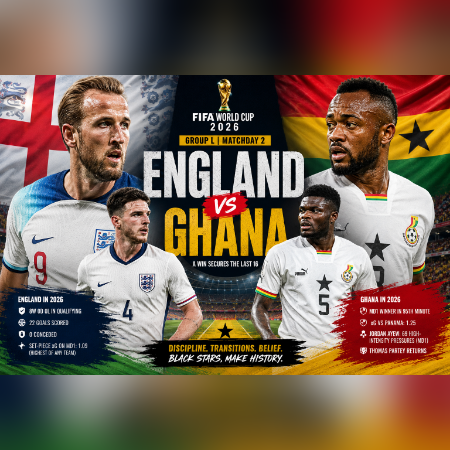
A draw would have left Ghana chasing results. A defeat would have made the upcoming encounter with England feel almost existential.
Instead, Queiroz's side can approach the next phase of the tournament with genuine opportunity.
The challenge is obvious.
Ghana will not enjoy the same margin for attacking inefficiency against stronger opponents. England, in particular, will punish periods of passive possession and indecision in the final third.
The defensive structure is promising.
The attacking structure remains unfinished.
Given that Queiroz took over only two months before the tournament, that imbalance is perhaps understandable. It is not, however, sustainable if Ghana intend to progress deep into the competition.
Verdict
Three points should never be dismissed at a World Cup.
Ghana earned them through persistence, discipline, and a moment of youthful courage from Caleb Yirenkyi. Those qualities deserve recognition.
But this victory should not be romanticized.
The Black Stars were second-best for portions of the contest. Panama created genuine danger. Ghana's attack frequently lacked imagination. Queiroz's loyalty to experienced players appeared, at times, to come at the expense of dynamism.
Yet there is also a reason experienced tournament coaches are trusted.
Queiroz understands that World Cups are not beauty contests. They are exercises in accumulation. Survive the difficult nights. Collect the points. Improve as the tournament unfolds.
Ghana have done the first part.
Whether they can do the second will determine whether Yirenkyi's stoppage-time winner becomes merely a memorable opening chapter or the beginning of a genuinely significant World Cup run.