Ghana is widely celebrated as one of Africa's most stable democracies. Since the return to constitutional rule in 1992, the country has conducted regular elections, witnessed peaceful transfers of power between competing political parties, and established democratic institutions that allow citizens to choose their leaders through the ballot box. In this regard, Ghana is undoubtedly a democracy.
Yet a closer examination of Ghana's political and social structure suggests that the country is not merely a democracy. It also exhibits significant features of a gerontocracy. A gerontocracy is a system in which political authority is concentrated in the hands of older persons, or where the elderly exercise disproportionate influence over governance and decision-making. While Ghana does not formally exclude younger citizens from political participation, age remains an important qualification for leadership in both the modern state and traditional political systems.
Age and Political Leadership
The 1992 Constitution stipulates that a person must be at least 40 years old to qualify for election as President of the Republic. This constitutional requirement reflects a belief that the office of the presidency demands maturity, experience, and sound judgment. By setting the minimum age at 40, the nation implicitly acknowledges that leadership is associated with the accumulation of life experience that often comes with advancing age.
Although younger Ghanaians can vote, organize politically, contest parliamentary elections, and hold various public offices, the highest political position in the land remains reserved for individuals who have reached middle age. Throughout Ghana's democratic history, presidents have generally been considerably older than the constitutional minimum age, further reinforcing the perception that national leadership is best entrusted to mature individuals.
Gerontocracy in Traditional Governance
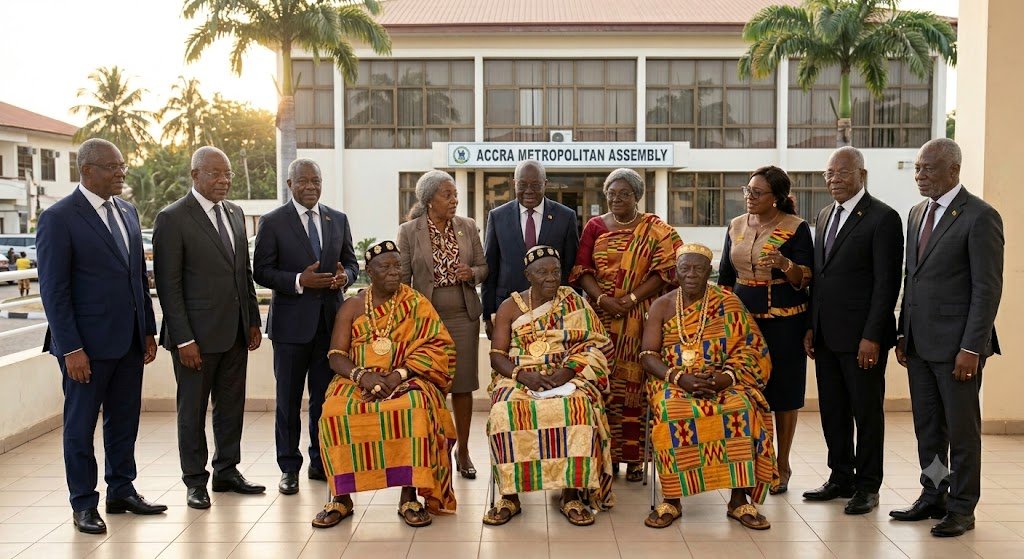
The influence of age is even more evident in Ghana's traditional political institutions. In many ethnic communities, chiefs are expected to be mature men possessing extensive knowledge of customary law, family histories, and community affairs. While eligibility for chieftaincy depends primarily on lineage and customary considerations, the selection of very young individuals as chiefs is uncommon.
Likewise, the elders who serve in the chief's court are usually advanced in age. Their role extends beyond merely advising the chief. They function as custodians of tradition, interpreters of customary law, mediators in disputes, and guardians of communal values. Their authority derives not only from their positions but also from their age and accumulated wisdom.
In many traditional settings, important decisions are reached through consultation with elders whose opinions command respect because they are believed to possess deeper insight into human affairs and community history than younger members of society.
Age as a Source of Wisdom
Underlying Ghana's gerontocratic tendencies is a deeply rooted cultural belief that age and wisdom are closely connected. Across the country, proverbs and cultural teachings emphasize respect for the elderly and acknowledge the knowledge that comes from long life experience.
Among many Ghanaian communities, it is commonly believed that an elder has witnessed events, solved problems, and acquired practical knowledge that younger people have not yet encountered. The elderly are therefore viewed as valuable repositories of wisdom, capable of providing prudent guidance during times of uncertainty and conflict.
This cultural orientation helps explain why older individuals frequently occupy positions of authority in families, communities, religious organizations, and political institutions. Leadership is often associated not only with competence but also with seniority.
The Place of Youth in Contemporary Ghana
While Ghana exhibits gerontocratic characteristics, it would be inaccurate to describe the country as a pure gerontocracy. Young people constitute a substantial proportion of the population and play increasingly important roles in politics, business, civil society, and the media. Youth activists, entrepreneurs, academics, and professionals continue to shape public discourse and influence national development.
Indeed, contemporary Ghana faces the challenge of balancing the wisdom and experience of older generations with the energy, innovation, and aspirations of younger citizens. Effective governance requires contributions from both groups. Excessive dependence on elderly leadership may limit opportunities for younger people, while the exclusion of elders would deprive society of valuable experience and institutional memory.
A Democracy with Gerontocratic Features
Ghana therefore represents an interesting blend of democracy and gerontocracy. It is democratic because political leaders ultimately derive their authority from the consent of the governed through elections. At the same time, it is gerontocratic because age continues to serve as an important qualification for leadership, both in constitutional governance and in traditional institutions.
The country's political culture reflects a longstanding conviction that older people possess qualities necessary for effective leadership. Whether in the presidency, chieftaincy, family governance, or community decision-making, age remains an influential factor in determining who governs and who advises.
Ghana's experience demonstrates that democracy and gerontocracy are not necessarily mutually exclusive. Rather, the country's political system combines democratic principles of popular participation with cultural traditions that place considerable trust in the wisdom of age. The result is a society that is both democratic in form and gerontocratic in important aspects of its leadership culture.