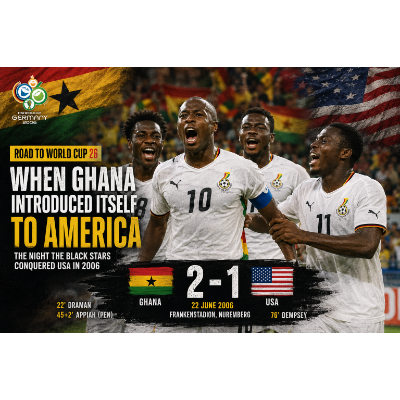
On June 22, 2006, inside the Frankenstadion in Nuremberg, Ghanaian football changed forever.
The noise was relentless. Drums echoed through the warm German evening air while thousands of Ghanaian supporters danced in the stands with the confidence of people who sensed history approaching. Across from them stood the United States — battle-tested, ambitious, and convinced they belonged among football’s rising powers after their impressive run to the quarterfinals four years earlier.
But that night did not belong to America.
It belonged to the Black Stars.
For ninety unforgettable minutes, Ghana announced themselves to the world not merely as Africa’s representatives, but as a football nation capable of standing toe-to-toe with anyone. Their 2–1 victory over the United States at the 2006 FIFA World Cup was more than a group-stage win. It was the beginning of Ghana’s modern football identity — fearless, technically gifted, emotionally charged, and unapologetically ambitious.
As the countdown to the 2026 FIFA World Cup continues, that victory still resonates deeply because it marked the moment Ghana stopped dreaming about belonging on the world stage and started acting like they already did.
Ghana’s Arrival at the Global Table
To understand the magnitude of the win over the United States, one must first understand the context surrounding Ghana before Germany 2006.
For decades, Ghanaian football had carried enormous promise. The country dominated youth football, winning multiple FIFA Under-17 World Cups and producing gifted footballers admired across Europe. Yet at senior level, World Cup qualification always seemed just beyond reach.
That changed when the Black Stars qualified for Germany 2006 ahead of continental giants such as Nigeria and South Africa.
Even then, many outside Africa treated Ghana as little more than enthusiastic outsiders. Their opening defeat against Italy appeared to confirm those assumptions. The Italians were clinical, experienced, and tactically superior.
But within the Ghanaian camp, panic never truly emerged.
Coach Ratomir Dujković understood he possessed a team capable of hurting elite opponents. More importantly, the players believed it too.
That belief exploded into life against the Czech Republic in Ghana’s second group game, when the Black Stars stunned the world with a thrilling 2–0 victory. Suddenly, qualification for the knockout stage became possible.
Standing in the way were the United States.
Winner takes all
The Match That Defined a Generation
The Americans entered the match under pressure after heavy defeats earlier in the tournament, but they still possessed experience, athleticism, and organization. Players such as Landon Donovan, Claudio Reyna, and Kasey Keller represented a generation determined to prove the United States belonged among football’s serious nations.
Ghana had different motivations.
The Black Stars were not fighting for respect anymore. They were fighting for history.
From the opening whistle, Ghana played with astonishing bravery. Their midfield pressed aggressively, refusing to allow the Americans rhythm or comfort. Michael Essien dominated physically and tactically, while Sulley Muntari snapped into challenges with furious intensity.
And then there was Stephen Appiah.
The captain played like a man carrying an entire nation on his shoulders.
In the 22nd minute, Ghana struck first. A dreadful defensive error from the Americans allowed Haminu Draman to burst through before calmly finishing beyond Keller.
The goal detonated the stadium.
For the first time, millions watching around the world began to understand the emotional force of Ghanaian football. The celebrations were not choreographed or restrained. They were raw expressions of national pride.
Yet the true quality of Ghana’s performance emerged after the Americans equalized through Clint Dempsey.
Lesser teams might have panicked.
Ghana responded by becoming even bolder.
Late in the first half, Appiah drove into the American penalty area with trademark determination before winning a controversial penalty after contact from defender Oguchi Onyewu. Debate over the decision continues to this day in American football circles, but Appiah cared little for the arguments.
He stepped forward and buried the penalty with supreme authority.
2–1.
History beckoned.
The Meaning Beyond the Scoreline
When the final whistle blew, Ghana had qualified for the Round of 16 in their very first World Cup appearance.
That achievement alone was extraordinary.
But the significance of the victory over the United States extended far beyond tournament mathematics.
This was the night Ghana shattered old stereotypes surrounding African football.
For decades, African teams had often been lazily described by European and American observers as “physical” or “chaotic” — talented but tactically naïve. Ghana demolished those assumptions. Against the United States, they were organized, intelligent, disciplined, and emotionally composed under pressure.
The midfield balance was exceptional. The transitions were sharp. The pressing structure disrupted the Americans repeatedly.
This was not an accidental upset.
This was a football nation arriving fully formed.
And perhaps that remains the most important aspect of the victory today.
Because Germany 2006 established the psychological foundation for everything Ghana would later achieve on the World Cup stage. Without beating the United States in Nuremberg, there is no quarterfinal run in South Africa four years later. There is no growing aura surrounding the Black Stars as Africa’s most dangerous World Cup side of the modern era.
That victory gave Ghana belief.
Not hope.
Belief.
Why the Match Still Matters in 2026
Twenty years later, the echoes of that night still matter profoundly as Ghana prepares for another World Cup journey — this time returning to North America.
The football world has changed dramatically since 2006.
The United States has invested heavily in youth development, coaching, infrastructure, and sports science. Their players now emerge from elite academies and compete regularly at top European clubs. The gap between football’s traditional and emerging powers has narrowed significantly.
Ghana, meanwhile, continue searching for a modern identity capable of matching the standards set by the golden generation.
That is why the memory of 2006 remains so powerful.
The Black Stars of that era possessed a clarity of purpose that modern Ghanaian teams sometimes lack. They understood exactly who they were. Aggressive in midfield. Fearless in transition. Emotionally resilient. Technically expressive.
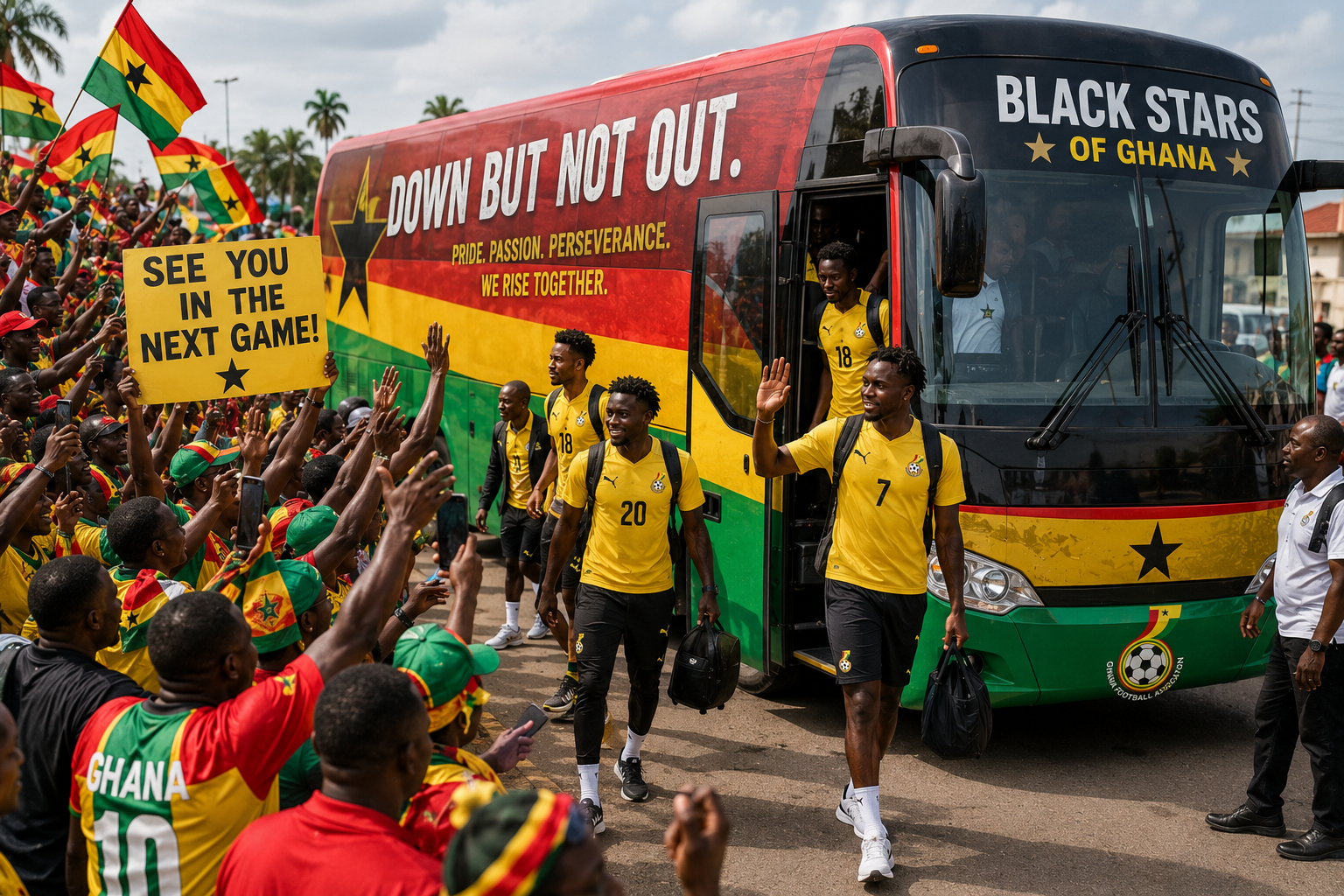
Today’s generation still carries immense talent. Antoine Semenyo embodies much of the attacking aggression and directness that once defined the Black Stars at their best, while Thomas Partey provides leadership and tactical control when fit.
But talent alone is never enough at World Cups.
Germany 2006 succeeded because Ghana combined talent with unity, tactical clarity, and absolute conviction.
That remains the challenge ahead of 2026.
Pundit’s Verdict
The victory over the United States in 2006 was not simply one of Ghana’s greatest World Cup results.
It was a declaration of footballing identity.
That night in Nuremberg proved Ghana could compete with established football nations not through luck or chaos, but through intelligence, courage, and collective belief. It announced the Black Stars as a serious force in world football and inspired an entire generation of African players to think bigger about what was possible on the global stage.
And perhaps that is why the match still resonates so deeply today.
Because modern Ghanaian football stands at another crossroads.
The world remembers the Black Stars as fearless pioneers capable of electrifying tournaments. The question now is whether the current generation can revive that spirit when the World Cup returns to North America in 2026.
If they can rediscover the hunger, discipline, and swagger of Nuremberg, Ghana will once again become dangerous opponents for anyone.
If not, the victory over the United States in 2006 risks becoming more than a historic triumph.
It risks becoming a memory from a golden age the Black Stars never fully recaptured.