Introduction: Sport as a Mirror of Ghana’s History
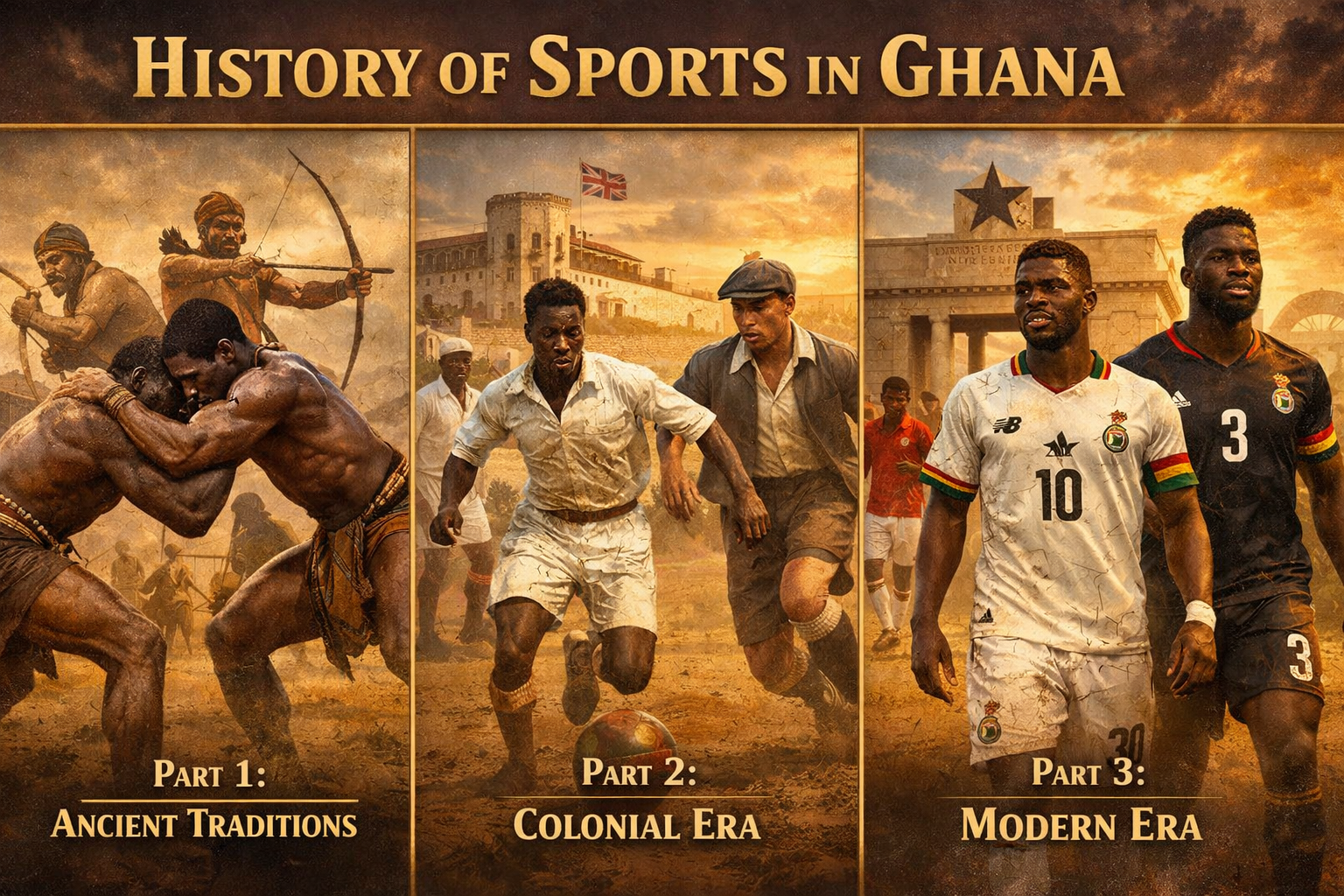
Long before Ghana was known by its modern name, sport and physical competition were already embedded in the social, political, and spiritual life of its people. From the ancient kingdoms of the Gold Coast to independence in 1957 and into the modern republic, sports have played a powerful role in shaping Ghana’s identity, unity, and international reputation.
This article explores how sports were born, nurtured, and transformed in Ghana, tracing their evolution from indigenous traditions to colonial influences and post-independence national pride.
- Indigenous Sports in Pre-Colonial Ghana (Before 1471)
Traditional Physical Activities and Community Life
Before European contact, sports in Ghana were not “games” in the modern sense but essential tools for survival, discipline, and cultural expression.
Common indigenous sporting activities included:
Wrestling (popular among Akan, Ewe, Dagomba, and Ga communities)
Stick fighting and mock battles
Hunting competitions
Long-distance running and endurance trials
Archery and spear throwing
These activities served multiple purposes:
Training young men for war and hunting
Building stamina and courage
Resolving disputes peacefully
Celebrating festivals and rites of passage
In Akan societies, wrestling matches often took place during festivals and were used to identify strong warriors and leaders.
- The Arrival of Europeans and the Shift in Sporting Culture (1471–1800s)
Early European Contact
The Portuguese arrival in 1471 marked the beginning of cultural exchange along the Gold Coast. While early European traders did not immediately introduce formal sports, their presence gradually influenced leisure activities.
As forts and castles emerged—Elmina Castle (1482), Cape Coast Castle, Christiansborg—European soldiers and merchants brought:
Recreational drills
Military games
Early forms of organized physical training
These practices laid the groundwork for structured sports later introduced under British colonial rule.
- Colonial Rule and the Introduction of Modern Sports (1821–1957)
British Colonial Influence
When the British formally colonized the Gold Coast in the 19th century, sports became a tool of discipline, education, and social control.
Sports introduced during this era included:
Football (soccer)
Cricket
Athletics (track and field)
Boxing
Tennis
These sports were initially reserved for:
European officials
Mission schools
Elite African schools
Mission Schools and Sports Education
Missionary institutions such as:
Mfantsipim School
Adisadel College
Achimota School
played a major role in spreading sports among Africans. Football fields and athletics tracks became central to school life.
- The Birth of Football in Ghana (1900s)
Football Takes Root
Football arrived on the Gold Coast in the early 20th century and quickly became the most popular sport.
Key milestones:
1903 – First recorded football matches in coastal towns
1912 – Formation of early local football clubs
1920s – Competitive football spreads nationwide
By the 1930s, football had become a unifying force across ethnic and social lines.
Formation of the Gold Coast Football Association
In 1920, the Gold Coast Football Association (GCFA) was formed, organizing leagues and competitions that laid the foundation for modern Ghanaian football.
- Sports and Nationalism Before Independence
Sports as Political Expression
By the 1940s and 1950s, sports—especially football—became deeply linked to nationalism.
African players began challenging racial segregation in clubs and leagues. Matches became gatherings where:
Anti-colonial ideas spread
National consciousness grew
Unity across tribes was strengthened
Football stadiums became spaces of resistance and pride.
- Independence and the Golden Age of Ghanaian Sports (1957–1970s)
Kwame Nkrumah and Sports as Nation-Building
After independence in 1957, President Kwame Nkrumah recognized sports as a powerful national tool.
Major developments:
Establishment of national sports councils
Investment in stadiums and training facilities
Government sponsorship of athletes
Birth of the Black Stars
The national football team was renamed the Black Stars, inspired by the Black Star of African freedom.
Achievements:
Africa Cup of Nations victories (1963, 1965)
Ghana becomes a continental sports powerhouse
Boxing legends like Azumah Nelson and athletics champions also emerged from this era.
- Sports in Modern Ghana (1980s–Present)
Global Recognition
Ghanaian sports gained global respect through:
FIFA U-17 and U-20 World Cup victories
Olympic medals
International boxing championships
Sports today serve as:
A pathway out of poverty
A tool for youth empowerment
A major cultural export
Conclusion: Sports as Ghana’s Living History
The history of sports in Ghana is inseparable from the nation’s broader story—from ancient traditions to colonial struggle, independence, and global recognition.
Sports have:
Preserved indigenous values
Strengthened national unity
Given Ghana a global voice
They remain one of Ghana’s strongest symbols of resilience, excellence, and identity.
Watch full video on YouTube – https://youtu.be/V61ogHlpMz8