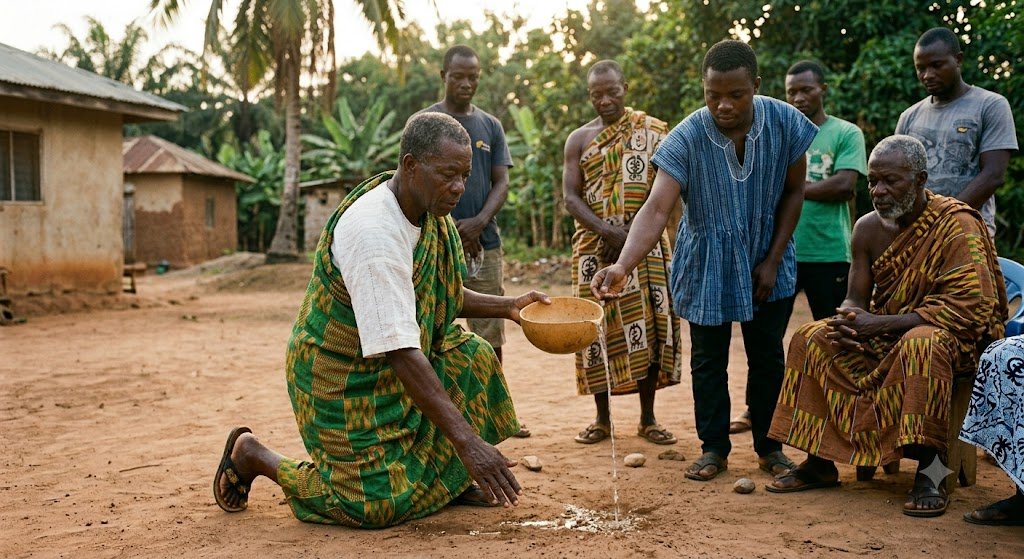
Asase Yaa, in the indigenous religion of the Akan people, is regarded as the great female spirit of the earth. She occupies a position of honor and importance second only to Nyankopon, the Creator. The Akan view the earth as a female spiritual being because of its fertility and its ability to produce and sustain life. They also think of the earth as a mother because human beings depend on it for food, shelter, and survival. Asase Yaa therefore plays a central role in Akan religious thought, as it is through her—especially through libation and other rituals—that the living maintain their connection with the ancestors.
Day Naming and Sacred Days
According to the Akan tradition of day-naming, she is called Asase (“earth”) Yaa (“female born on Thursday”) because many Akan believe that Nyankopon created the earth on a Thursday. Among the Fante, however, who believe that the earth was created on a Friday, she is known as Asase Efua (“female born on Friday”). In both traditions, the day associated with her is regarded as sacred. On that day, farming activities such as tilling the soil are prohibited, and the dead are not buried. Actions that might disrespect or pollute the earth are also avoided. More generally, the earth should not be disturbed without first seeking Asase Yaa’s permission through the pouring of libation. Those who fail to observe these customs are believed to face serious spiritual consequences.
Spiritual Attributes and Mediating Role
Akans believe that Asase Yaa possesses a spirit (sunsum). She is also regarded as the wife of Nyankopɔn (Nyankopɔn yere). In addition, she serves as a mediator between the living and the dead, and between human beings and God. Akans further view her as a good mother (obaatan pa) who cares for all people. Because of this maternal role, many believe that when prayers and requests are presented before her, she conveys them to the Most High God.
Importance in Libation and Ritual Life
Asase Yaa is invoked immediately after Nyankopon during the pouring of libation, and the first offering to the ancestors is usually made in her name. Since libation is the principal means through which the Akan begin religious ceremonies, perform traditional rituals, conduct political proceedings, and mark important events, Asase Yaa occupies a highly important place in Akan spiritual life. In everyday religious practice, her presence is nearly as prominent as that of Nyankopon.
Ceremonial and Moral Significance
Respect for Asase Yaa is expressed in many Akan ceremonies. During an outdooring (naming) ceremony, after a newborn child has been given a name, the infant is placed on the ground or on a mat as a sign of gratitude to Asase Yaa for preserving the child’s life and to the ancestors for their protection and guidance.
During ayie (funeral rites), libation is poured to Asase Yaa to seek her permission before a grave is dug and to ask her to receive and protect the body of the deceased. She is also regarded as a guardian of truth. In everyday life, a person suspected of lying may be challenged to touch the tip of their tongue to the earth as proof of honesty.