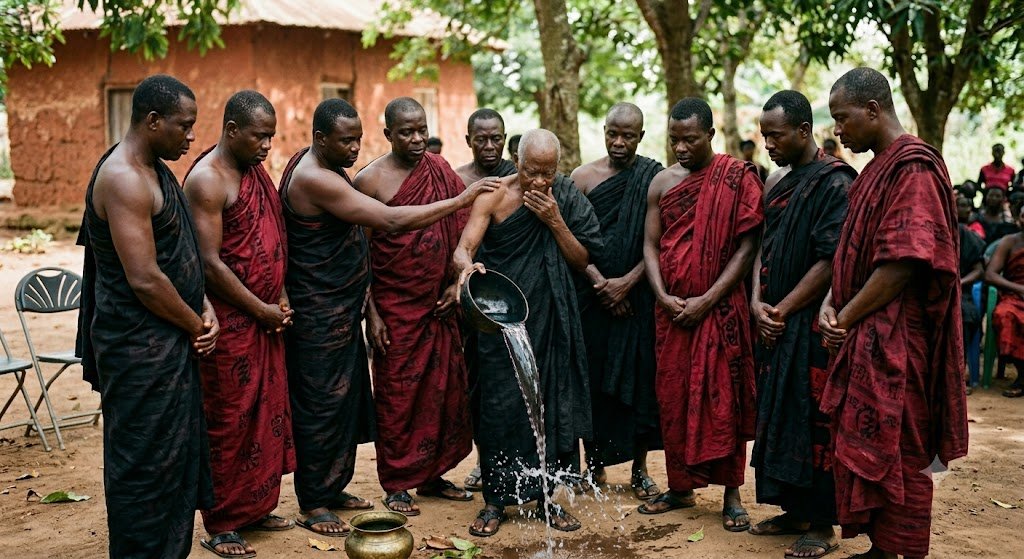
One of the most important features of Akan religious and funeral traditions is the pouring of libation, known in Twi as nsaguo or mpaeyie. The word nsaguo literally means the pouring of an alcoholic drink, while mpaeyie refers to the offering of prayers or supplications. The two concepts go hand in hand because the pouring of drink is almost always accompanied by prayers, invocations, and communication with ancestors and spiritual beings.
For the Akan, libation is much more than a ceremonial act. It is a sacred form of communication between the living, the dead, and the spiritual world. Through libation, blessings are sought, guidance is requested, and respect is shown to ancestors and deities. It is therefore an integral part of funeral rites and other important traditional ceremonies.
Libation is poured at several stages of the funeral process, including:
When the corpse is being bathed. When the grave is being dug. When the deceased is being placed in the casket. When the casket is being covered with earth at the cemetery. During the one-week observance (nnaawɔtwe) following death. During the twentieth-day observance (adaduonu). During the fortieth-day observance (adaduannan). During the eightieth-day observance (adaduɔwɔtwe). During the one-year anniversary (afehyiada). When a person dies what is traditionally regarded as a "bad death" (atɔfowuo), libation is poured and prayers are said before the body is removed from the place of death. When death occurs at a shrine or the residence of a traditional priest (abosomfie), libation is offered to appease the deity (obosom) because death is believed to have ritually contaminated the sacred space. In all these situations, libation serves as both a spiritual cleansing ritual and a means of maintaining harmony between the physical and spiritual worlds. It acknowledges the presence and continuing influence of ancestors while seeking divine protection and guidance for the living.
Although religious beliefs in Ghana have become increasingly diverse, the pouring of libation remains an enduring aspect of Akan culture and funeral practice. For many families, it continues to provide a meaningful way of honouring the dead, preserving tradition, and reinforcing the bond between generations.