Conspicuous Consumption and the Funeral Arena
The term “conspicuous consumption” was coined by the American economist and sociologist Thorstein Veblen in his classic work The Theory of the Leisure Class published in 1899. Veblen used the concept to describe the public display of wealth through extravagant expenditure on luxury goods and ceremonies for the purpose of gaining prestige, social recognition, and status distinction. Conspicuous consumption has been a feature of societies throughout history. In virtually every culture, individuals and families have employed lavish displays of wealth to distinguish themselves socially and to communicate power, prestige, and economic success.
In many societies, funerals have become one of the principal arenas for conspicuous consumption because death rituals are public events that attract large gatherings of kin, affines, friends, neighbors, and community members. Within the Ghanaian context, especially among the Akan, funerals have increasingly become sites for the dramatic display of wealth, social influence, and family prestige. Expenditures on expensive coffins, elaborate funeral posters, designer mourning cloths, luxurious food and drinks, brass bands, live musical performances, video coverage, and funeral receptions have often attracted public criticism. Critics argue that funerals have become excessively commercialized and financially burdensome. In recent years, adesiedie has emerged as yet another highly visible dimension of conspicuous consumption within Akan mortuary rituals and practices.
Grave Goods and the Journey to Asamando
Traditionally, grave goods deposited into the coffin served symbolic and spiritual purposes. Within Akan cosmology, the deceased embarks upon a journey to Asamando, the land of the dead or ancestral realm. This journey was traditionally believed to last approximately forty days and was imagined as difficult, rugged, and spiritually demanding. Consequently, family members placed various personal effects and utilitarian objects into the coffin to assist the deceased during the journey. Toiletries such as towels, sponge, soap, and pomade were included to enable the deceased to bathe and freshen themselves along the way. Additional clothing was provided so that the deceased could change garments during the long spiritual journey. Money was also deposited into the coffin to pay for transportation and other expenses that might be encountered on the road to Asamando. These practices reflected an enduring Akan belief in the continuity between earthly existence and existence in the ancestral world.
From Symbolic Provision to Public Spectacle
Over time, however, these grave goods have undergone considerable transformation both in quantity and symbolism. In contemporary Ghana, especially in Akan communities, adesiedie has evolved into a spectacular public performance characterized by the ostentatious presentation of expensive items by in-laws, extended family members, and associates of the deceased. Rather than merely serving the spiritual needs of the deceased, these presentations increasingly function as demonstrations of wealth, migration success, social standing, and economic achievement.
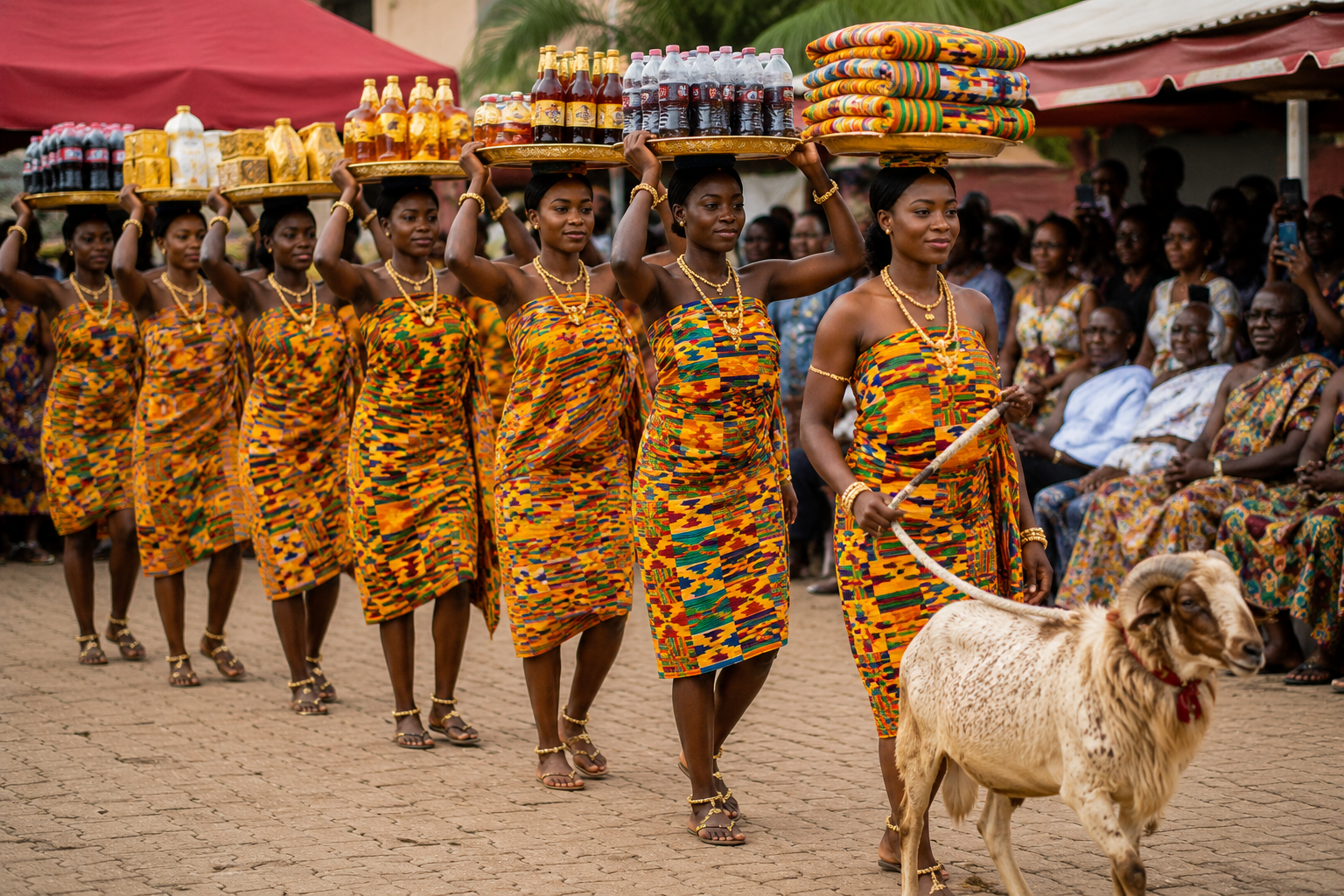
The items displayed during adesiedie ceremonies often include large quantities of expensive cloth for both men and women, imported alcoholic beverages such as whisky, cognac, gin, and schnapps, boxes of shoes, designer bags, jewelry, cosmetics, expensive watches, mattresses, refrigerators, television sets, and occasionally household appliances. Imported items are especially prized because they symbolize prestige, cosmopolitanism, and access to foreign economic opportunities. Foreign-manufactured liquor is often preferred over locally produced alcoholic beverages because imported goods are associated with superior status and affluence. The more expensive and visually impressive the items, the greater the symbolic prestige attached to the donor family.
Diaspora Prestige and Transnational Symbolism
In some cases, the display assumes highly theatrical dimensions. Reports exist of live sheep and goats decorated with the flags of the United States, Britain, Canada, Germany, and other Western nations. Such symbolism serves to publicly advertise the diasporic connections of the donor family and to communicate that the contributors are based abroad. The use of national flags and imported commodities transforms the funeral arena into a symbolic stage upon which migration success and transnational achievement are publicly performed before the community.
The Performance of Wealth
To heighten the spectacle and visual grandeur of the ceremony, organizers frequently recruit entourages of attractive young women and girls, sometimes dressed in revealing or glamorous attire, to carry the items ceremonially on their heads during public processions. These choreographed displays transform the funeral into a performative social event marked by pageantry, spectacle, and competition. The visual display is often carefully recorded by professional videographers and photographers for circulation on social media platforms, thereby extending the audience for the performance beyond the immediate funeral grounds.
The contemporary adesiedie ceremony is deeply embedded within social comparison and competitive display. Families consciously compare funeral performances, and many seek to outdo others in the scale, extravagance, and sophistication of their presentations. Funeral ceremonies have therefore become important sites for symbolic competition, status rivalry, and the pursuit of social recognition. In some communities, the prestige associated with a funeral may significantly shape public perceptions of a family’s social standing for years afterward. Consequently, families may feel intense social pressure to organize elaborate adesiedie ceremonies even when doing so imposes severe financial strain.
Public Criticism and Moral Debates
Critics have strongly condemned these developments. Many argue that adesiedie represents wasteful expenditure in a country still confronted with significant socioeconomic challenges, including poverty, unemployment, hunger, inadequate housing, and shortages of medical supplies and educational resources. From this perspective, the enormous financial resources devoted to funeral spectacle could be redirected toward socially productive purposes such as scholarships, hospitals, community development projects, libraries, orphanages, and assistance to vulnerable individuals and families.
Others criticize the moral contradictions associated with these practices. It is frequently observed that some deceased persons may not have received adequate care while alive, particularly during periods of illness, old age, or economic hardship. Yet following their death, enormous sums of money are suddenly mobilized for lavish funeral ceremonies and extravagant adesiedie displays. Critics therefore question the ethical logic of neglecting individuals during life while honoring them extravagantly after death.
Defending Adesiedie: Honor, Solidarity, and Prestige
Despite these criticisms, defenders of adesiedie argue that the ceremony fulfills important social and cultural functions. They contend that funerals provide opportunities for families to demonstrate solidarity, honor the deceased, strengthen affinal relations, and publicly affirm collective identity and success. In a highly communal society where social visibility and reputation matter greatly, public generosity during funerals is often interpreted as evidence of love, respect, and familial commitment. Furthermore, because funerals are among the few occasions that bring together dispersed kin networks, they serve as important sites for social reunion, networking, and the reaffirmation of social bonds.
Globalization, Consumerism, and Changing Funeral Culture
The rise of adesiedie also reflects broader processes of globalization, consumerism, urbanization, and social change within contemporary Ghanaian society. Exposure to global consumer culture through migration, satellite television, social media, and transnational networks has intensified desires for luxury consumption and public display. Consequently, funerary culture has increasingly absorbed the aesthetics and values of modern consumer capitalism. What was once primarily a spiritual and symbolic practice has gradually evolved into a major arena for economic display and performative consumption.
Conclusion
Ultimately, the adesiedie ceremony illustrates the dynamic and changing nature of Akan mortuary rituals. It demonstrates how traditional funeral customs continuously adapt to new economic realities, social aspirations, and global cultural influences. While some view adesiedie as a legitimate expression of honor and communal solidarity, others interpret it as evidence of growing materialism and the commercialization of death. The phenomenon therefore remains an important lens through which to examine contemporary Ghanaian society, changing conceptions of prestige and success, and the intersection between culture, consumerism, and mortuary practice.