Introduction: When Two Revolutions Met
The friendship between Kwame Nkrumah and Ahmed Sékou Touré was not a casual diplomatic acquaintance. It was an ideological alliance forged in the furnace of anti-colonial struggle, tempered by Cold War pressures, and sustained by a shared belief that Africa’s future lay in unity rather than fragmentation.
Though often described simply as “friends,” their relationship was far more complex: they were political comrades, strategic allies, ideological co-travelers in Pan-Africanism, and at times, embattled leaders isolated by Western powers and domestic opposition. Their story is also one of ambition—grand, unfinished, and deeply instructive.
Pan-Africanism as a Meeting Ground
The intellectual and political bridge between Nkrumah and Sékou Touré was Pan-Africanism, a philosophy that envisioned a united Africa free from colonial domination and neo-colonial influence.
Nkrumah, Ghana’s first Prime Minister and later President, emerged as one of the most vocal advocates of continental unity after Ghana became the first sub-Saharan African colony to gain independence in 1957. He believed political independence without economic and military unity would leave African states vulnerable.
Sékou Touré, who led Guinea to independence from France in 1958 after a historic “No” vote in the French constitutional referendum, shared a similarly uncompromising anti-colonial stance. His decision to reject continued association with France placed Guinea in immediate diplomatic and economic isolation, a sacrifice that earned him admiration among radical African nationalists, including Nkrumah.
Their ideological convergence was not accidental—it was rooted in a shared conviction that Africa’s liberation required bold rupture, not gradual reform.
The Ghana–Guinea Union: A Bold Experiment
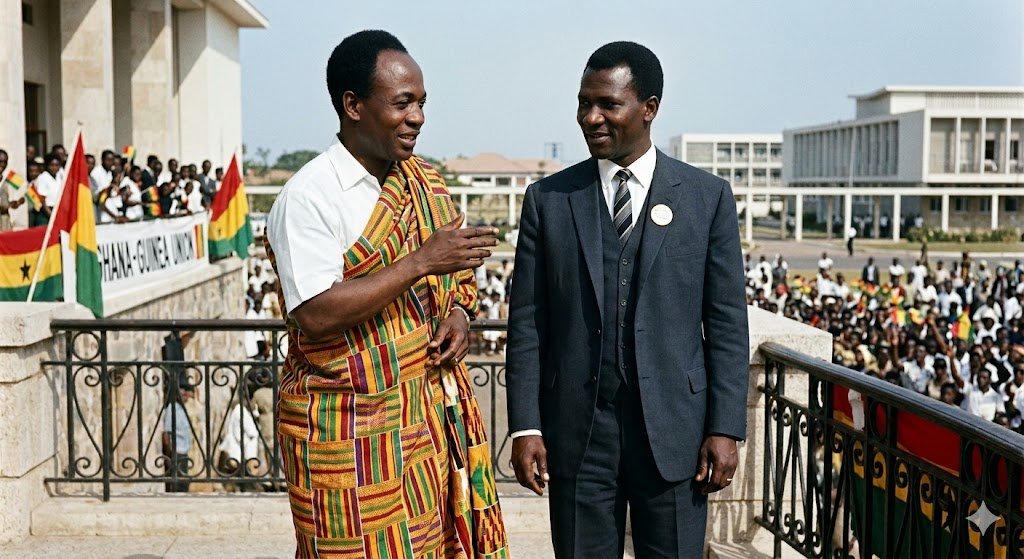
The friendship between the two leaders became institutionalized in 1958 when Ghana and Guinea entered into a political union—the first serious attempt at post-colonial African integration.
This Ghana–Guinea Union was a symbolic and political statement to the world: African unity was not a distant dream but a present possibility. Nkrumah and Touré agreed on mutual defense cooperation, diplomatic alignment, and joint consultation on foreign policy.
The union was later expanded in principle to include Mali under President Modibo Keïta, forming what was sometimes referred to as the Ghana–Guinea–Mali Union. Although the union remained more aspirational than fully operational, it represented a radical challenge to the emerging norm of African state sovereignty defined by colonial borders.
Behind the symbolism, however, lay real political intent: both leaders sought to build a counterweight to Western influence in West Africa and to demonstrate that African states could pool sovereignty without losing identity.
Shared Ideology in a Divided Cold War World
The Cold War provided the broader geopolitical backdrop for their friendship. Both leaders rejected strict alignment with either the United States or the Soviet Union, even though they leaned toward socialist economic planning and state-led development.
Nkrumah’s “Consciencism” and Touré’s “African socialism” were intellectual frameworks that attempted to adapt socialist principles to African realities. They emphasized communal ownership, anti-imperialism, and the centrality of African cultural values.
However, their positions made them targets of suspicion in Western capitals. Both leaders were accused of authoritarian tendencies, economic mismanagement, and excessive centralization of power. These criticisms—whether fair or exaggerated—further pushed them into each other’s political orbit.
In many ways, their friendship became a refuge from international isolation. Each saw in the other a mirror of their own struggles: leaders attempting to transform newly independent states while navigating internal dissent and external pressure.
Personal Bonds and Diplomatic Solidarity
Beyond ideology, there was also genuine personal affinity. Nkrumah and Touré frequently exchanged visits, communiqués, and symbolic gestures of solidarity.
Nkrumah’s presence in Conakry was particularly significant. Guinea became one of Ghana’s closest allies in West Africa, offering political backing at a time when Nkrumah’s domestic popularity was becoming increasingly strained.
Touré, in turn, publicly defended Nkrumah’s vision of African unity at international forums, often positioning Guinea as a radical voice in continental politics. Their speeches frequently echoed each other’s language—unity, liberation, dignity, and resistance to neo-colonialism.
This was not merely ceremonial diplomacy. It reflected a shared emotional investment in the idea that African leaders must stand together against fragmentation, even when internal disagreements emerged.
The 1966 Coup and the Turning Point
The most dramatic test of their friendship came in February 1966, when Nkrumah was overthrown in a military coup while he was on a state visit to Vietnam and China.
The coup, carried out by Ghana’s military and police forces, abruptly ended Nkrumah’s presidency and sent shockwaves across the continent. Many African leaders quickly adjusted to the new regime in Accra, but Sékou Touré took a dramatically different stance.
He immediately denounced the coup as illegitimate and invited Nkrumah to Guinea, offering him full political asylum. This act was not merely humanitarian—it was deeply political. It signaled Touré’s refusal to recognize regimes that emerged from what he viewed as neo-colonial interference or internal betrayal.
In Conakry, Nkrumah was received not as a defeated politician but as a revered Pan-African statesman.
Nkrumah in Exile: Honorary Co-President of Guinea
Perhaps the most extraordinary chapter in their friendship unfolded in Guinea after 1966. Sékou Touré granted Nkrumah the title of Honorary Co-President of Guinea, an unprecedented political arrangement in modern African history.
Although largely symbolic, the gesture carried immense ideological weight. It affirmed that Nkrumah’s political vision had not ended with his overthrow. In Guinea, he continued to write, reflect, and engage with Pan-African ideas, supported by Touré’s government.
Nkrumah’s exile years were marked by intellectual productivity, producing works that further elaborated his critique of neo-colonialism and his vision for continental unity. Touré ensured that he remained politically secure, providing residence, security, and diplomatic recognition.
Their relationship during this period evolved into something even more profound: a partnership in political memory-making. Together, they embodied the idea that leadership was not solely tied to office, but to enduring ideological purpose.
The Limits and Contradictions of Their Alliance
Despite its symbolic strength, the Nkrumah–Touré friendship was not without contradictions. Both leaders governed states that faced accusations of political repression and centralization of authority. Their commitment to unity sometimes came at the expense of political pluralism.
Moreover, the Ghana–Guinea Union never fully matured into a functioning supranational state. Economic disparities, administrative challenges, and regional political complexities limited its effectiveness.
Critics have argued that their vision of unity was overly reliant on charismatic leadership rather than institutional frameworks. Others maintain that they were ahead of their time, attempting continental integration decades before conditions were ripe.
Whatever the interpretation, their alliance remains one of the boldest political experiments in Africa’s post-independence history.
Legacy: A Friendship Larger Than Its Time
The friendship between Kwame Nkrumah and Ahmed Sékou Touré endures as a symbol of Pan-African aspiration. It represents a moment when African leaders seriously attempted to transcend colonial borders and construct a shared political destiny.
Though their political projects faced setbacks, their vision continues to inspire debates on African unity, regional integration, and sovereignty. Institutions such as the African Union echo, in modified form, some of the ideas they championed decades earlier.
Their friendship also serves as a reminder that political alliances are not only shaped by treaties and interests but also by shared beliefs, emotional solidarity, and historical necessity.
In the end, Nkrumah and Touré were not merely friends in the conventional sense. They were co-architects of an unfinished dream—one that still lingers in the imagination of Africa’s political future.