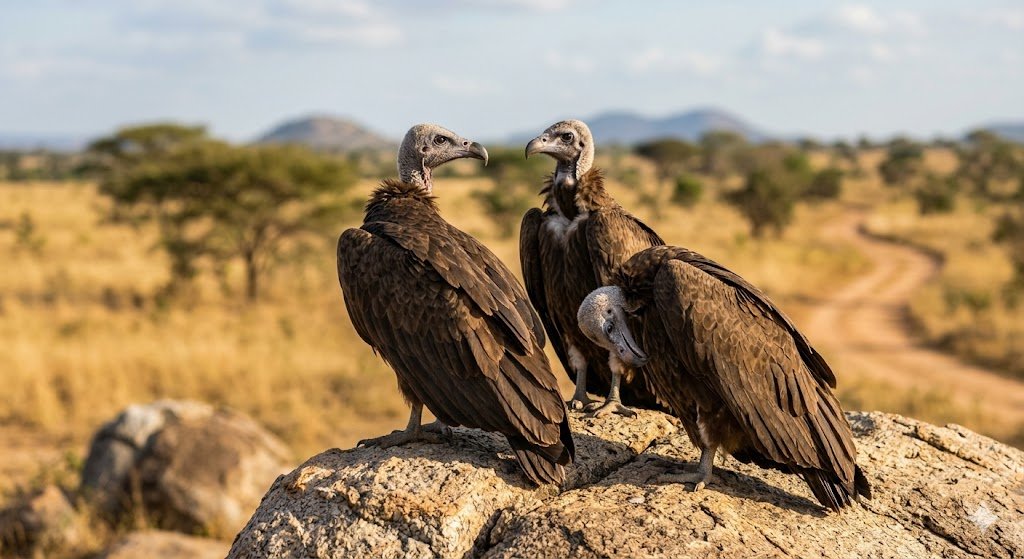
Vultures Were A Once Familiar Presence in Ghana’s Skies
About fifty years ago, vultures were a common sight across Ghana. One could hardly walk a short distance without encountering them. They perched on trees, lined the rooftops of buildings, circled above garbage dumps, and gathered wherever refuse or animal carcasses could be found. Indeed, vultures seemed to be everywhere.
As scavengers, vultures played an important ecological role. Whenever an animal died, they would descend in large numbers, sometimes a dozen or more at a time, competing noisily over the carcass until little remained. Their presence was so familiar that children even composed songs about them and sang them with delight. Those were truly different times.
In Nkawkaw in Ghana’s Eastern Region, vultures regularly gathered atop a prominent multi-storey building in the heart of town, not far from the slaughterhouse. Over time, the building became popularly known as Mpete Aban—literally, “the vultures’ storey building.”
Today, however, the story has changed dramatically. Vultures have all but disappeared from many parts of Ghana. Spotting even a single vulture has become a rare occurrence. Their sudden scarcity has become so noticeable that many people are now asking the same question: Where have all the vultures gone?
To answer that question, we conducted some inquiries into the disappearance of vultures in Ghana. What we discovered was both revealing and troubling.
The Vulture Population in the Past
No one can state with absolute precision the number of vultures that once existed in Ghana. However, historical accounts and lived experience point to a time when vultures were extraordinarily abundant. In both rural and urban settings, they were a constant presence in the sky and on the ground.
Their abundance was closely tied to the ecological and sanitary conditions of the time. Open refuse dumps, unregulated slaughterhouses, and indiscriminate disposal of animal waste created a steady supply of carrion. Older generations recall that it was common to see dozens of vultures congregating at a single site, particularly in markets, abattoirs, and settlement peripheries.
Their visibility also meant cultural familiarity. Vultures were not merely birds of the sky; they were part of everyday urban and rural landscapes, woven into observation, storytelling, and even children’s play.
The Present Situation: A Dramatic Population Collapse
In stark contrast to the past, Ghana’s vulture populations have undergone a severe and widely documented decline. Conservation assessments suggest that vulture numbers across West Africa have dropped by more than 80–90 percent over recent decades, with Ghana reflecting this regional pattern.
Species such as the Hooded Vulture, once highly visible in towns and cities, have experienced particularly steep declines. While precise national population estimates remain difficult due to limited long-term monitoring, conservation organizations and wildlife experts generally agree that only a few thousand vultures of all species may now remain in Ghana.
Even more concerning is their uneven distribution. Where vultures once dominated urban environments, they are now largely absent. Sightings have become rare, isolated, and often restricted to more remote or less disturbed habitats.
What are the Causes of the Decline in Vultures’ Population?
Poisoning and Secondary Toxicity
One of the most significant drivers of vulture decline is poisoning. In many parts of Africa, including Ghana, poisoned carcasses are used to eliminate predators such as hyenas, jackals, or stray dogs. Vultures, as obligate scavengers, become unintended victims when they feed on these carcasses.
In some cases, poisoning is deliberate and targeted. Poachers may poison carcasses to kill vultures themselves, particularly because circling vultures can reveal illegal hunting activities. A single poisoned carcass can kill dozens of birds, producing catastrophic local population losses.
Urban Transformation and Habitat Loss
The transformation of Ghana’s urban landscape has also played a major role. Modern waste management systems, improved sanitation, and regulated abattoir practices have significantly reduced the availability of accessible carrion. While these changes are beneficial for public health, they have inadvertently removed a critical food base for vultures.
At the same time, urban expansion has led to the loss of large trees and undisturbed structures that once served as nesting and roosting sites. The disappearance of such habitats has further reduced breeding success.
Chemical Contamination and Environmental Pollution
The use of agricultural chemicals and pesticides introduces another layer of risk. Toxic substances can accumulate in animal carcasses and enter the food chain, causing secondary poisoning in scavenging birds. Environmental pollution more broadly weakens ecosystems and reduces biodiversity, indirectly affecting vulture survival.
Traditional Beliefs and Illegal Wildlife Trade
In some communities, vultures are still hunted for use in traditional medicine and spiritual practices. Certain body parts are believed to possess supernatural properties associated with protection, foresight, or fortune. Although such practices vary in intensity across regions, they contribute to unnecessary mortality among already vulnerable populations.
Infrastructure-Related Mortality
Modern infrastructure has also introduced new hazards. Vultures are sometimes electrocuted when perching on power lines or collide with cables, wind turbines, and communication masts during flight. These deaths, while less visible, contribute cumulatively to population decline.
Climate Variability and Ecological Stress
Climate change adds an indirect but important pressure. Altered rainfall patterns, prolonged droughts, and habitat degradation affect wildlife populations that vultures depend on indirectly. As ecosystems become more unstable, the availability of carcasses becomes less predictable, further stressing scavenger populations.
Ecological and Public Health Implications
The disappearance of vultures carries serious ecological consequences. Vultures perform an essential sanitation function by rapidly disposing of dead animals. Their highly acidic digestive systems neutralize pathogens that would otherwise persist in the environment.
Without vultures, carcasses remain longer in the open, attracting alternative scavengers such as dogs and rats, which are more likely to transmit diseases to humans and livestock. In other regions where vultures have declined sharply, increases in diseases such as rabies and other infections have been linked to this ecological gap.
Their decline also signals broader environmental imbalance. A sudden collapse in a once-abundant species suggests systemic ecological stress, including habitat loss, pollution, and biodiversity degradation.
Cultural Loss and Collective Memory
Beyond ecological consequences, the disappearance of vultures represents a subtle cultural loss. For older generations, vultures formed part of the visual and symbolic landscape of everyday life. They appeared in folklore, informal storytelling, children’s songs, and shared urban memory. Their absence therefore reflects not only environmental change but also a fading layer of lived cultural experience.
Conclusion: An Ecological Warning Sign
The near disappearance of vultures in Ghana is not an isolated phenomenon but part of a broader environmental narrative. It reflects the intersection of poisoning, urban change, cultural practices, and ecological disruption.
Whether vultures can recover depends on coordinated conservation efforts, stronger enforcement of wildlife protection laws, and greater public awareness of their ecological importance. What remains clear is that their absence is more than symbolic. It is a warning signal—one that speaks to the health of Ghana’s environment and the fragile balance that sustains it.