From Childhood Fascination to Lifelong Pacifism
My father used to tell us stories about the Second World War. As children, we listened with a mixture of awe and excitement. The accounts of military armaments, battlefield tactics, territorial conquests, and the celebration of war heroes and heroines captivated our imagination. In our youthful innocence, some of us even expressed the wish that war would occur in our lifetime so that we could witness such dramatic events firsthand.
My father, however, warned us sternly not to entertain such thoughts. He emphasized the profound suffering, destruction, and irreversible human costs that accompany war. That cautionary lesson became a turning point in my moral development. From that day forward, I ceased to romanticize war. I became, in principle and conviction, a pacifist—a conscientious objector in spirit—committed to the belief that human beings should never willingly seek or glorify armed conflict.
Today, as a military sociologist who has studied numerous wars across historical and contemporary contexts, I am even more convinced of my father’s wisdom. My academic engagement with military institutions, combat training systems, martial subcultures, leadership structures, and weapons technologies has only deepened my understanding of war not as heroic spectacle, but as a profound social tragedy.
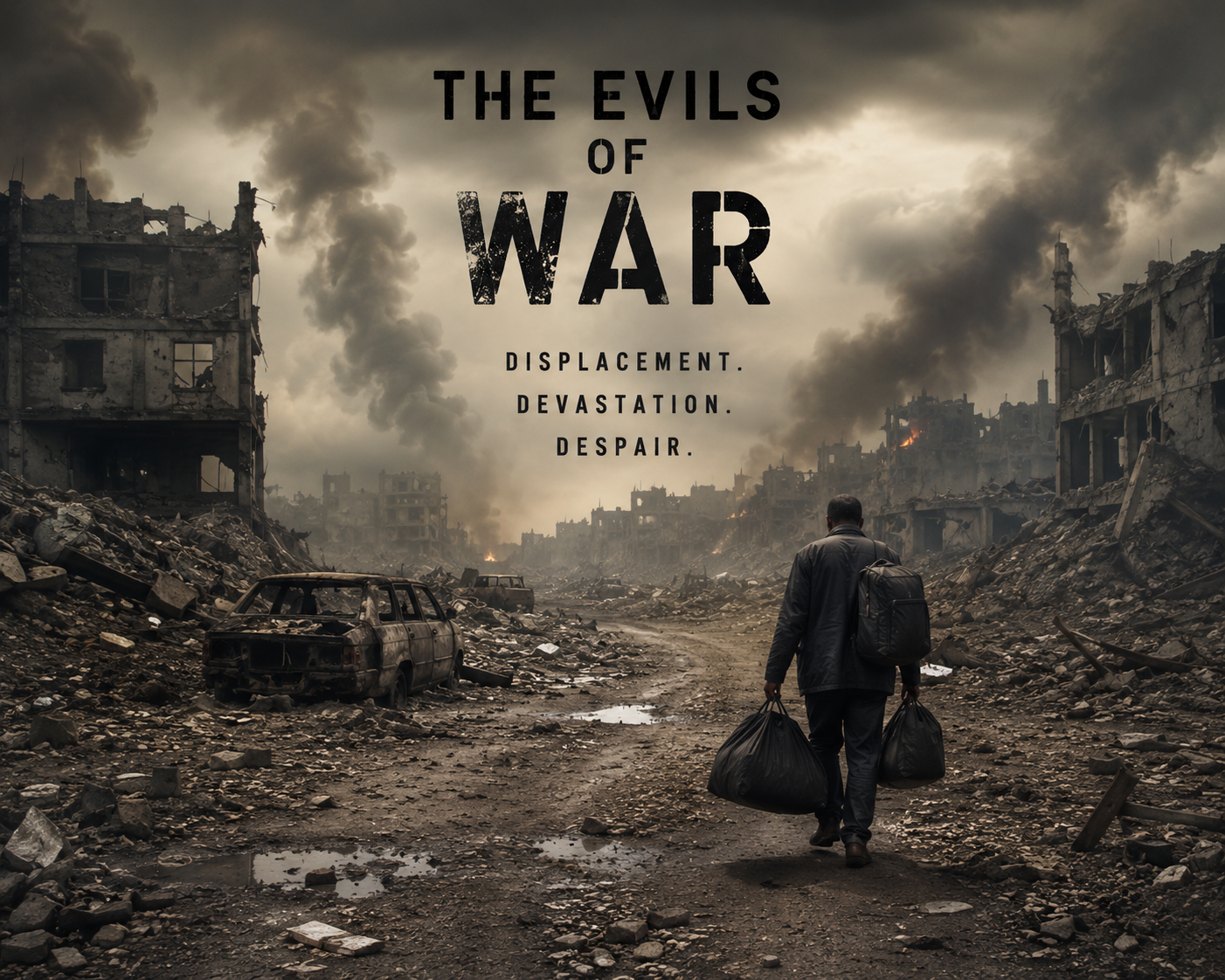
What follows is a sociological reflection on the fundamental evils of war.
The Human Cost: Death, Injury, and Irreversible Loss
At its most basic level, war is mass death. It produces casualties on a scale that defies ordinary comprehension. Thousands, sometimes millions, of lives are extinguished in a relatively short period. These are not abstract numbers; they represent fathers, mothers, children, friends, and community leaders whose lives are abruptly terminated.
Beyond death lies another layer of suffering—injury. Many thousands more survive war with permanent physical disabilities. Limbs are lost, senses impaired, and bodies permanently altered. For many survivors, life after war becomes a lifelong negotiation with pain, dependency, and social stigma.
Family Disintegration and Social Fragmentation
War does not only destroy individuals; it dismantles families. Parents are separated from children. Spouses are torn apart. Siblings lose contact in the chaos of displacement and flight. The family unit, which is the fundamental building block of society, becomes fractured under the pressure of violence and forced migration.
In many cases, reunification never occurs. Entire family lineages are disrupted, creating generational voids that echo long after the guns have fallen silent. What is often overlooked in strategic analyses of war is this intimate, human dimension of social disintegration.
Famine, Hunger, and the Collapse of Food Systems
War also destroys the economic and agricultural foundations of society. Food production is disrupted as farmers flee conflict zones or are conscripted into military service. Farmlands become battlefields. Supply chains collapse. Markets cease to function.
The result is widespread hunger and famine. Civilians, who are often not direct participants in the conflict, become its most vulnerable victims. In such contexts, starvation becomes not merely a consequence of war, but a weapon within it.
Destruction of Infrastructure and National Development
Another devastating consequence of war is the destruction of infrastructure. Roads, bridges, hospitals, schools, and utilities are damaged or completely obliterated. This destruction sets societies back by decades, erasing years of development in a matter of weeks or months.
The cost of rebuilding is immense, often diverting scarce national resources away from education, health, and economic development toward reconstruction and emergency relief. War, in this sense, is development in reverse.
Disruption of Education and the Theft of the Future
Education systems are among the first casualties of war. Schools are closed, teachers displaced, and students forced to abandon their studies. In refugee settings, educational continuity is severely compromised or entirely absent.
The long-term consequence is profound: a generation of children loses access to stable education, thereby narrowing their future opportunities. War, therefore, does not only destroy the present; it actively steals the future.
Orphanhood and the Creation of Vulnerable Populations
War produces large numbers of orphans. Children who lose one or both parents are left vulnerable to exploitation, neglect, and psychological trauma. Many are absorbed into already overstretched extended family systems, while others end up in displacement camps or on the streets.
The social burden of caring for war orphans becomes an additional strain on already weakened communities.
Psychological Trauma and Invisible Wounds
The psychological consequences of war are often less visible but equally devastating. Witnesses and survivors of war violence frequently suffer from long-term mental health conditions, including post-traumatic stress disorder, anxiety, depression, and emotional numbing.
These invisible wounds affect not only individuals but also entire societies. Communities carry collective trauma that influences social relations, trust, and cohesion long after the cessation of hostilities.
The Manufacture of Enemies and the Persistence of Hatred
Perhaps one of the most enduring consequences of war is the creation of lasting enmity. War does not simply end with peace agreements; it often institutionalizes hatred between former adversaries. Entire populations may come to view one another through the lens of historical grievance and collective blame.
This perpetuation of hostility increases the likelihood of future conflict, creating cycles of violence that are difficult to break.
Conclusion: A Call for Critical Reflection
War, when examined sociologically, is not a heroic enterprise but a profound human catastrophe. It dismantles families, destroys economies, interrupts education, produces trauma, and generates long-lasting cycles of hatred.
My father’s warning remains as relevant today as it was in my childhood. War should never be romanticized. It should be understood, studied, and ultimately resisted. For in the final analysis, the true measure of any society is not its capacity for destruction, but its commitment to preserving life, dignity, and peace.