Introduction
Pet ownership is a common and deeply entrenched aspect of life in many Western societies such as the United States, Canada, Australia, New Zealand, and several European countries. In the United States alone, estimates for 2025 suggested that tens of millions of households owned pets, including over 65 million dogs and approximately 45 million cats. Beyond dogs and cats, many households also keep exotic pets such as snakes, turtles, rabbits, monkeys, parrots, and tropical birds. In these societies, pets are often regarded as members of the family. They may live indoors, sleep on beds and sofas, receive specialized medical treatment, and even possess insurance coverage. Pet ownership is associated with companionship, emotional support, recreation, and social prestige.
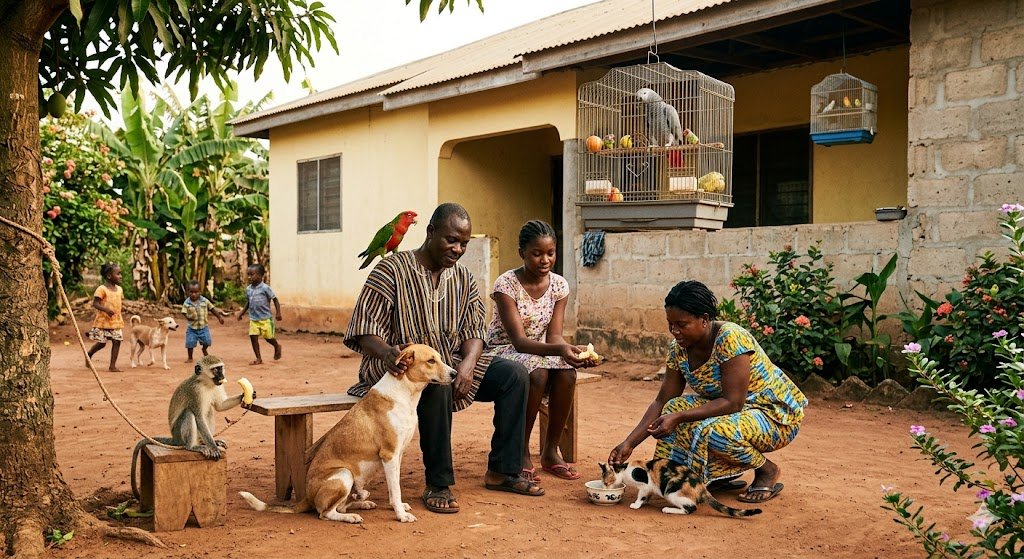
In Ghana, however, pet ownership exists within a different cultural, economic, and spiritual context. Although many households keep animals, the practice of keeping pets mainly for companionship is less widespread than in Western societies. Reliable national statistics on the number of pets in Ghana do not exist, making it impossible to determine the exact population of domestic dogs and cats. Nevertheless, dogs and cats remain the most commonly kept pets in the country. Other animals occasionally kept as pets include parrots, pigeons, rabbits, monkeys, tortoises, and ornamental birds.
Dogs as the Dominant Pet
Among all pets in Ghana, dogs are by far the most popular and socially valued. Traditionally, dogs have long served practical purposes in Ghanaian society. They are kept to guard homes, protect farms, accompany hunters into the bush, and deter thieves. In many rural communities, a household without a dog is considered vulnerable to robbery and spiritual attacks.
Dogs are also valued for their perceived loyalty and sociability. Ghanaians commonly describe dogs as friendly, protective, and emotionally attached to humans. Unlike cats, dogs openly interact with household members, greet owners enthusiastically, and are seen as capable of forming strong emotional bonds with people. These characteristics have contributed greatly to their popularity.
In contemporary urban Ghana, ownership of expensive foreign dog breeds has become a status symbol. Imported breeds such as German Shepherds, Rottweilers, Boerboels, Bull Mastiffs, and Pit Bulls are especially prized among middle-class and affluent households. Owning such dogs is often interpreted as evidence of wealth, prestige, and modernity. In elite neighborhoods of Accra, Kumasi, and Takoradi, it is not uncommon to see wealthy individuals walking imported breed dogs as symbols of social status and success.
Cats and Spiritual Beliefs
Although cats are common in Ghanaian households, cat ownership is generally less popular than dog ownership. Part of this difference stems from cultural and spiritual beliefs surrounding cats. In many Ghanaian communities, cats are regarded with a degree of suspicion and mystical fear. Unlike dogs, which are often associated with protection and loyalty, cats are sometimes linked to witchcraft, bad omens, and supernatural phenomena.
One widespread belief is that when a domestic cat suddenly disappears from the household and never returns, it signifies that a member of the family may soon die. Such disappearances are interpreted not merely as ordinary animal behavior but as spiritual signs or ominous warnings. This belief can create anxiety and unease among household members.
Cats are also considered less sociable and emotionally expressive than dogs. Many people describe cats as secretive, aloof, and independent animals that roam freely and often disappear for long periods. Because of these characteristics, some Ghanaians view cats as mysterious creatures whose actions cannot easily be understood or trusted.
In some traditional belief systems, cats are associated with witches and nocturnal spiritual activities. Their ability to move quietly in darkness, combined with their glowing eyes at night, has historically contributed to mystical interpretations of their behavior. Consequently, while many households tolerate cats because they help control rats and mice, they are less frequently pampered or emotionally cherished in the same way dogs are.
Dogs and Spiritual Protection
Dogs themselves occupy an important place in Ghanaian supernatural beliefs. In many communities, people believe dogs possess the ability to perceive spiritual entities invisible to human beings. Excessive barking by dogs at night is often interpreted as evidence that the animal has seen witches traveling to nocturnal meetings, ghosts passing through the area, or other supernatural beings lurking nearby.
Some people believe dogs can sense impending danger, evil spirits, or death before humans become aware of them. For this reason, a dog’s unusual behavior may be treated seriously within households. A dog that persistently barks toward a dark corner, empty road, or bush at night may create fear among family members who interpret the behavior spiritually rather than naturally.
These beliefs reinforce the cultural importance of dogs not merely as security animals but also as spiritual protectors capable of alerting humans to unseen dangers.
Urban and Rural Differences in Pet Ownership
Pet ownership patterns differ considerably between urban and rural Ghana. In rural communities, animals are usually kept for practical or economic reasons. Dogs assist in hunting and security, while cats help control rodents that threaten stored food. Emotional attachment to pets certainly exists, but the relationship is often more utilitarian than sentimental.
Urban pet ownership increasingly resembles Western patterns. Middle-class and upper-class families are more likely to keep pets for companionship, name them, vaccinate them, groom them, and seek veterinary treatment for them. Social media has also contributed to changing attitudes, with many young Ghanaians posting photographs and videos of their pets online.
Nonetheless, unlike in many Western countries, most pets in Ghana are still kept outside the home. Dogs are commonly housed in kennels or tied within compounds, while cats move freely between homes and surrounding areas. Historically, allowing animals to share beds, couches, or dining spaces with humans was viewed by many as unhygienic or culturally inappropriate.
Challenges of Pet Ownership in Ghana
Keeping pets in Ghana comes with numerous challenges. Veterinary services remain limited, especially in rural areas. Access to trained veterinarians, animal hospitals, vaccines, and medication is often difficult and expensive. Rabies outbreaks continue to pose public health concerns because many dogs remain unvaccinated.
Feeding pets also presents challenges. Imported pet food is expensive, forcing many owners to rely on household leftovers and improvised feeding methods. Ghana’s tropical climate creates additional problems, including ticks, fleas, skin infections, and heat-related difficulties for imported dog breeds adapted to cooler environments.
Housing conditions also affect pet ownership. In crowded urban compounds and rented apartments, landlords often prohibit pets because of concerns about noise, smell, and property damage.
Pets as Food and Commercial Commodities
Another controversial aspect of pet ownership in Ghana is that some animals regarded as pets elsewhere are also consumed as food. In certain communities, dogs and cats may be eaten during social gatherings or drinking sessions. Some owners sell aging or unwanted dogs to buyers involved in the dog meat trade when the animals become less useful for security or hunting purposes.
Occasionally, reports emerge of stolen dogs being sold for meat, causing distress to owners who regarded the animals as companions. These practices highlight the coexistence of two competing cultural attitudes toward animals: one viewing them as companions deserving affection and protection, and the other treating them primarily as utilitarian or consumable commodities.
Conclusion
Pet ownership in Ghana reflects a fascinating intersection of culture, spirituality, tradition, modernization, and social class. While dogs and cats remain the most common pets, attitudes toward animals continue to evolve. Dogs occupy a privileged position because of their perceived loyalty, usefulness, and spiritual protective abilities, while cats are often viewed more cautiously because of longstanding mystical beliefs associated with them.
Urbanization, globalization, social media exposure, and rising incomes are gradually transforming pet ownership practices, especially among younger urban populations. Nevertheless, economic realities, traditional beliefs, limited veterinary infrastructure, and differing cultural attitudes continue to shape how pets are perceived and treated in Ghanaian society. As the country modernizes, pet ownership is likely to become increasingly widespread, emotionally significant, and socially visible in the years ahead.