What Is Multilingualism?
Multilingualism refers to the ability of individuals or societies to speak and use more than one language. A multilingual person may speak two, three, or even several languages, while a multilingual society is one in which many different languages coexist and are used in everyday life. In Africa, multilingualism is not an exception but the norm, and Ghana stands as one of the continent’s most linguistically vibrant nations.
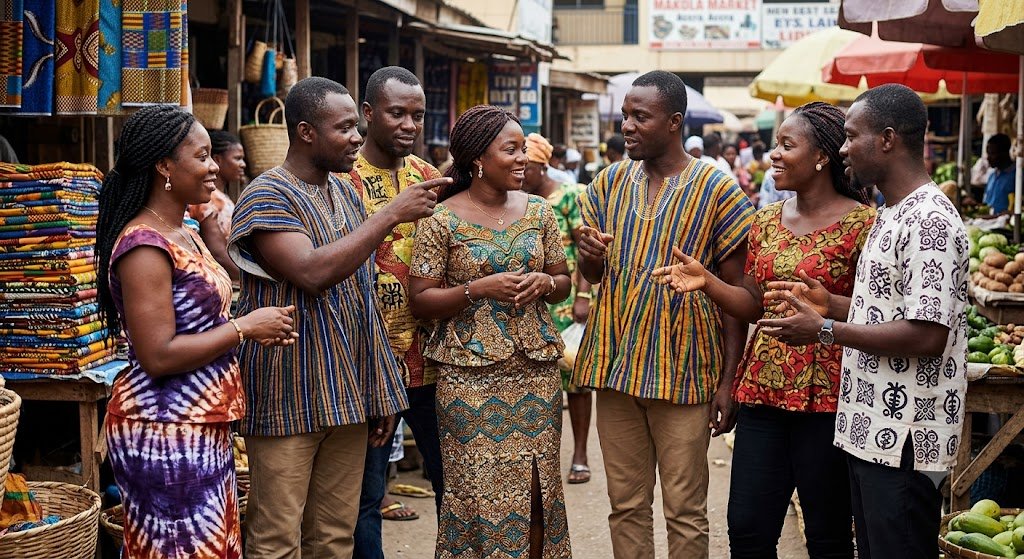
In Ghana, language is closely connected to ethnicity, culture, trade, politics, and identity. From the bustling streets of Accra, the capital city, to the markets of Kumasi and Tamale, one often hears several languages spoken within the same conversation. Many Ghanaians effortlessly move from English to Twi, Ga, Ewe, Dagbani, Hausa, or Pidgin English within minutes. This remarkable linguistic flexibility has become one of the defining features of Ghanaian society.
Ghana’s Ethnic and Linguistic Diversity
Ghana is home to more than seventy ethnic groups, each with its own linguistic and cultural heritage. Major ethnic groups include the Akan, Mole-Dagbani, Ewe, Ga-Adangbe, Guan, Gurma, Grusi, and Mande peoples.
Closely linked to this ethnic diversity is Ghana’s extraordinary linguistic diversity. Linguistic studies estimate that between 73 and 83 living languages are spoken in Ghana, although the most widely accepted estimate is around 79 to 81 languages.
English remains the official language of the country, inherited from British colonial rule. It is the language of government administration, formal education, the judiciary, and much of the media. However, indigenous Ghanaian languages continue to dominate daily social interaction and cultural life.
Among the most commonly spoken languages in Ghana are Akan (especially Twi and Fante), Ewe, Ga, Dagbani, Dagaare, Nzema, Gonja, and Kasem. Akan is by far the most widely spoken indigenous language and serves as an informal lingua franca in many parts of southern Ghana.
A Nation of Bilinguals and Multilinguals
Ghana is one of the most multilingual countries in Africa. Exact statistics on bilingualism and multilingualism are difficult to obtain because many people speak different languages with varying levels of fluency. Nevertheless, scholars generally agree that the overwhelming majority of Ghanaians are bilingual or multilingual.
Available estimates suggest that nearly half of the population is bilingual in English and at least one Ghanaian language. Some studies estimate that approximately 46 percent of Ghanaians above the age of eleven are literate in both English and a Ghanaian language.
In practice, the percentage of people who can speak both English and another language conversationally is likely much higher, especially in urban areas. Indeed, multilingualism is so widespread that monolingualism is often regarded as unusual rather than normal.
A substantial proportion of Ghanaians can also speak three or more languages. In many homes, a child may grow up speaking a mother tongue at home, learn Twi or another regional lingua franca in the marketplace, and acquire English in school. In cosmopolitan cities such as Accra and Kumasi, many residents additionally learn Ga, Hausa, or Pidgin English for commercial and social interaction. Scholars therefore describe multilingualism in Ghana as “the norm rather than the exception.
Nkrumah and the Language Question
After independence in 1957, the government of Kwame Nkrumah faced a difficult question: should Ghana adopt one indigenous national language to promote unity?
Nkrumah strongly believed in national integration and Pan-African unity. However, he recognized the political dangers involved in selecting one Ghanaian language over others. Any attempt to elevate a single ethnic language to national status risked provoking ethnic tensions and accusations of favoritism.
Consequently, Nkrumah maintained English as the official language while simultaneously encouraging the study and development of Ghanaian languages in schools and cultural institutions. His educational policies promoted bilingualism by allowing Ghanaian languages to be used alongside English at the lower levels of education.
Why Ghana Could Not Choose One Lingua Franca
The search for a single national lingua franca has always been politically sensitive in Ghana. Akan, especially Twi, is the most widely understood indigenous language and is spoken far beyond Akan ethnic boundaries. Yet attempts to make Akan the sole national language have historically faced resistance from non-Akan groups who feared cultural domination.
Ewe speakers, Ga speakers, northern ethnic groups, and smaller linguistic communities have often preferred the continued use of English because it is viewed as ethnically neutral. English therefore became a compromise language that avoided privileging one ethnic group over another.
Another difficulty lies in the sheer linguistic complexity of Ghana. Many Ghanaian languages have numerous dialects, some mutually intelligible and others less so. Even within Akan itself, dialectal differences exist between Asante Twi, Akuapem Twi, and Fante. Similar variations occur among northern languages as well.
What Promotes Multilingualism in Ghana?
Several factors continue to foster multilingualism in Ghana.
First is migration and urbanization. Cities such as Accra, Kumasi, Takoradi, and Tamale attract people from all parts of the country. Daily interaction among different ethnic groups naturally encourages language learning.
Second is trade and commerce. Market women, transport operators, artisans, and traders often learn multiple languages to communicate with customers from different ethnic backgrounds.
Third is intermarriage. Increasingly, marriages occur across ethnic lines, leading children to grow up speaking more than one Ghanaian language.
Fourth is education. Ghana’s educational system has long included the teaching of Ghanaian languages in schools, especially at the basic level. Several indigenous languages are officially recognized for educational purposes.
The media also play an important role. Radio and television stations broadcasting in Twi, Ga, Ewe, Dagbani, and other languages have expanded dramatically over the past three decades. Music, films, social media, and comedy programs further promote multilingual communication.
Finally, religion contributes significantly to multilingualism. Churches and mosques often conduct services in several languages to accommodate diverse congregations.
The Future of Multilingualism in Ghana
The future of multilingualism in Ghana appears strong, although not without challenges.
On one hand, globalization and the increasing importance of English continue to strengthen the position of English as the language of higher education, international business, and technology. Many parents now prioritize English proficiency for their children, sometimes at the expense of indigenous languages.
On the other hand, Ghanaian languages are showing remarkable resilience. Local language broadcasting, digital translation projects, Ghanaian language publishing, and social media content creation are helping indigenous languages remain vibrant in the modern era. New initiatives in artificial intelligence and language technology are also beginning to support Ghanaian languages online.
The likely future is therefore not the disappearance of multilingualism but its transformation. English will remain dominant in formal domains, while indigenous languages will continue to flourish in cultural, religious, commercial, and social life.
Ghana’s multilingualism is not a weakness. It is one of the nation’s greatest cultural assets. It reflects centuries of coexistence, adaptation, and interaction among diverse peoples. In a world increasingly divided by ethnic and cultural tensions, Ghana’s multilingual experience offers an important lesson: unity does not require linguistic uniformity.