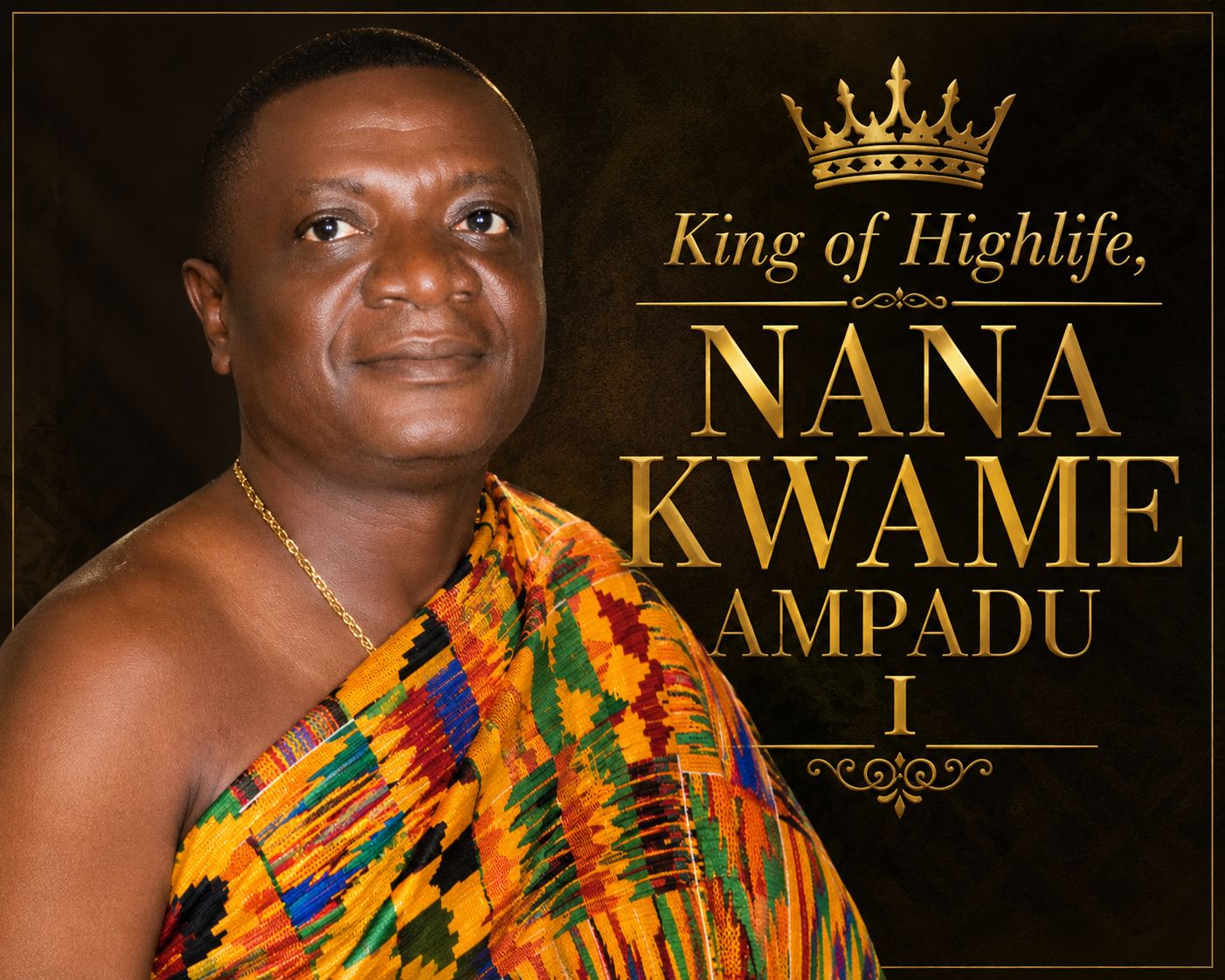
King of Highlife, Nana Ampadu
Among the pantheon of Ghanaian musicians who shaped the soundscape of modern West African music, few names command the reverence accorded to Nana Kwame Ampadu I. A composer, guitarist, vocalist, storyteller, and cultural philosopher, Nana Ampadu stood as one of the most prolific and influential highlife musicians in Ghanaian history. Through his immense repertoire of songs, he chronicled the social realities, moral dilemmas, cultural traditions, and everyday experiences of Ghanaian society. His music transcended mere entertainment; it became a cultural archive, a moral classroom, and a sociological commentary on Ghanaian life.
The passing of Nana Kwame Ampadu I on September 28, 2021, marked the end of an extraordinary era in Ghanaian music. Yet, his songs continue to resonate deeply across generations, reminding Ghanaians and Africans more broadly of the enduring power of indigenous music rooted in language, folklore, proverbial wisdom, and social consciousness. His contributions to highlife music and Ghanaian culture remain monumental.
His Birth
Nana Kwame Ampadu I was born in 1945 in the small Kwahu town of Obo and was christened Paa Steele Kwame Ampadu. His birth in the culturally rich Kwahu area of Ghana profoundly influenced his worldview, linguistic style, and artistic sensibilities. The Kwahu area has historically produced many notable Ghanaian personalities in business, politics, religion, and the arts, and Nana Ampadu emerged as one of its greatest musical sons.
Growing up in Akan society exposed him to the rich oral traditions of storytelling, proverbial speech, dirges, folktales, and indigenous philosophy. These cultural resources later became the lifeblood of his musical compositions. Unlike many performers whose works centered primarily on dance rhythms, Nana Ampadu cultivated a style in which lyrical content occupied center stage. The moral lessons embedded in Akan oral traditions profoundly shaped his later career as a songwriter and social commentator.
His Musical Career
The illustrious musical career of Nana Kwame Ampadu began in 1960. At a relatively young age, he demonstrated immense musical talent as a guitarist, vocalist, and composer. In 1963, he formed the legendary African Brothers International Band, a musical group that would become one of the most celebrated highlife bands in Ghanaian history. The formation of the band marked a decisive turning point not only in his life but also in the development of Ghanaian highlife music.
The African Brothers International Band quickly rose to prominence because of its unique fusion of captivating rhythms and intellectually engaging lyrical texts. Nana Ampadu distinguished himself from many contemporaries through his emphasis on meaningful storytelling and social commentary. His songs addressed themes that ordinary Ghanaians could immediately identify with—family relations, morality, migration, poverty, betrayal, death, witchcraft, destiny, and social injustice.
By 1978, within roughly fifteen years of the band’s formation, the African Brothers International Band had reportedly released over 400 single highlife tracks, a feat that testified to Nana Ampadu’s astonishing creativity and productivity. His mastery of composition enabled him to continuously produce songs that retained freshness while speaking directly to Ghanaian lived realities.
In 1972, the Government of Ghana organized a nationwide competition among music bands to determine the country’s best local highlife group. After a rigorous year-long competition, the African Brothers International Band emerged victorious. As leader of the band, lead guitarist, organist, vocalist, composer, and arranger, Paa Steele Kwame Ampadu was crowned the “King of Highlife Music.” On February 10, 1973, he was officially conferred with the title Nwontofohene—King of Musicians.
Following this coronation, he adopted the name Nana Kwame Ampadu I, symbolizing both royal musical authority and cultural distinction. The title reflected the immense respect he commanded within Ghanaian musical circles and among the wider public.
Beyond performance, Nana Ampadu also served Ghanaian music institutionally. He became Vice-President of the Musicians Union of Ghana (MUSIGA), where he contributed to the advancement and welfare of Ghanaian musicians. Even after retiring from active performance and composition, he remained influential as a mentor and scriptwriter for local Ghanaian films.
His Compositions
One of the defining features of Nana Ampadu’s career was his extraordinary gift for composition. He is widely regarded as the most prolific Ghanaian musician of all time. Over a musical career spanning more than five decades, he reportedly composed over 800 songs and produced more than 70 albums. Such staggering productivity places him among the great musical composers not only in Ghana but also across Africa.
Nana Ampadu’s compositions were deeply rooted in Akan oral traditions. He skillfully incorporated proverbs, maxims, folktales, epithets, and symbolic animal characters into his lyrical narratives. Through this approach, his songs achieved both artistic elegance and educational significance.
Importantly, Nana Ampadu viewed music as a vehicle for instruction and moral guidance. In a 1987 interview, he stated that audiences paid greater attention to lyrics than to rhythm or instrumental performance. Consequently, he endeavored to ensure that the lyrical content of his music was always meaningful and socially relevant.
Many of his compositions addressed pressing social issues confronting Ghanaian society. His celebrated song Yen Ba Pa Kwadwo, for instance, narrates parental advice given to a young man embarking on a journey in search of greener pastures. The song urges discipline, hard work, prudence, and avoidance of alcoholism, promiscuity, and bad company. The song functioned both as entertainment and as moral instruction for young people.
Other compositions focused on cultural preservation and the importance of maintaining African traditions amid modernization and westernization. Through such songs, Nana Ampadu encouraged Ghanaians to embrace Sankofa—the principle of returning to retrieve valuable cultural traditions from the past.
His works also addressed death, destiny, funerary rituals, poverty, witchcraft, and interpersonal conflicts. Particularly notable was his deep engagement with Akan cosmology and indigenous belief systems. His songs frequently referenced witchcraft and spiritual causation, themes deeply embedded in Akan worldviews. Through storytelling and lyrical dramatization, he presented vivid portrayals of human suffering, jealousy, betrayal, and supernatural fears within Ghanaian society.
His Music
The music of Nana Kwame Ampadu cannot be fully appreciated merely as popular entertainment. His songs constituted a sociological and cultural commentary on Ghanaian society. Ethnomusicologists and music scholars have long argued that music serves multiple social functions, including education, social criticism, preservation of culture, and the expression of collective emotions. Nana Ampadu’s music embodied all these functions.
In Ghanaian society, music has traditionally accompanied important rites of passage such as birth, marriage, and death. Music has also been employed to educate citizens on social issues ranging from public health to patriotism. Nana Ampadu harnessed this educational dimension of music masterfully.
The lyrical texts of his songs offered profound insights into Ghanaian social life. An outsider listening attentively to his music could learn much about Akan beliefs, family structures, moral expectations, religious ideas, and social tensions. His songs reflected everyday struggles and aspirations while simultaneously reinforcing communal values.
His musical style was distinguished by narrative richness. Many songs unfolded almost like short stories or morality plays. Through vivid characterization and dramatic storytelling, he transformed ordinary social experiences into memorable musical narratives. This storytelling ability made his music intellectually engaging and emotionally compelling.
Equally significant was his use of the Akan language. Nana Ampadu elevated Akan linguistic expression through sophisticated use of proverbs and idioms. His songs enriched Ghanaian folklore and preserved indigenous wisdom at a time when many feared cultural erosion. During the silver jubilee celebration of the African Brothers International Band in 1988, a government official praised him for enriching Ghanaian cultural heritage through his extensive use of Akan proverbial expressions and anecdotes.
His Contributions to Global Music
Although deeply rooted in Ghanaian culture, Nana Ampadu’s influence extended beyond Ghana’s borders. Highlife music itself became one of West Africa’s most important musical exports, influencing musicians across the African continent and within the African diaspora. Through his prolific output and distinctive style, Nana Ampadu contributed significantly to the global recognition of Ghanaian highlife.
His music demonstrated that African languages and indigenous philosophical traditions could serve as sophisticated vehicles for artistic expression and social critique. At a time when many African musicians were heavily influenced by Western musical forms, Nana Ampadu remained unapologetically grounded in African cultural aesthetics.
His songs resonated with Africans living both within and outside the continent because they addressed universal human concerns—love, betrayal, death, morality, migration, greed, and destiny. Through storytelling and culturally grounded narratives, he projected Akan and Ghanaian experiences onto the global stage.
Moreover, his emphasis on lyrical depth influenced subsequent generations of Ghanaian musicians. Many contemporary highlife and hiplife artists continue to draw inspiration from his storytelling methods, proverbial style, and social consciousness. His legacy therefore survives not only in recordings but also in the artistic traditions he helped institutionalize.
He Is Another Kwahu Legend
The Kwahu area of Ghana has produced numerous distinguished personalities, and Nana Kwame Ampadu occupies a revered place among these legends. He stands as a towering cultural ambassador of Kwahu identity and Akan civilization. Through his music, he projected the linguistic richness, philosophical depth, and artistic sophistication of Akan culture to national and international audiences.
His success brought prestige to his hometown of Obo and to the broader Kwahu area. He demonstrated that a musician grounded in local traditions could achieve national and continental acclaim without abandoning indigenous identity. In this regard, Nana Ampadu symbolized cultural authenticity and artistic excellence.
Even after his death in 2021, he continues to be remembered fondly as one of Kwahu’s greatest sons—a legendary musician whose works remain woven into the cultural memory of Ghana.
His Prolific Music
Perhaps no single description captures Nana Kwame Ampadu more accurately than the term “prolific.” Few musicians in African history have matched the sheer volume and consistency of his musical production. With over 800 songs and more than 70 albums to his credit, his contribution to Ghanaian music is unparalleled.
Yet, the significance of his prolificacy lies not merely in numbers but in substance. His songs consistently combined entertainment with wisdom, humor with seriousness, and artistry with cultural education. He produced music that ordinary people could dance to while simultaneously reflecting on profound social truths.
His enduring popularity stemmed from his ability to speak directly to the Ghanaian condition. Whether discussing family tensions, migration, poverty, death, or witchcraft, Nana Ampadu captured the emotional and moral complexities of life in Ghanaian society. His music therefore became part of the social fabric of Ghana itself.
In the final analysis, Nana Kwame Ampadu I was more than a musician. He was a cultural philosopher, historian, educator, and custodian of Akan oral traditions. His death on September 28, 2021, represented the loss of a monumental artistic figure, but his music remains immortal. Through his songs, generations of Ghanaians continue to encounter the wisdom, humor, morality, and cultural richness that defined his extraordinary life and accomplishments.