Introduction
Among Ghana’s sixteen administrative regions, few can rival the Western Region in terms of natural wealth, cultural diversity, economic importance, and historical significance. Stretching along the Gulf of Guinea in the southwestern corner of the country, the region is blessed with abundant mineral resources, fertile agricultural lands, rich forests, productive fishing grounds, and some of the most beautiful tourist attractions in Ghana. It is also the birthplace of several distinguished Ghanaians who have played prominent roles in the nation’s political, economic, academic, and cultural development.
The Western Region is more than a geographical area. It is a region that has helped shape the history and destiny of modern Ghana.
Location and Physical Features
The Western Region is situated in the southwestern part of Ghana. It shares an international boundary with Côte d’Ivoire to the west, borders the Central Region to the east, and lies along the Atlantic Ocean to the south. The regional capital is Sekondi-Takoradi, Ghana’s twin-city metropolis and one of the country’s most important commercial and industrial centers. The region covers approximately 13,842 square kilometers and includes Ghana’s southernmost point, Cape Three Points, where commercial quantities of crude oil were discovered in 2007. The region also boasts numerous rivers, including the Ankobra, Pra, Bia, and Tano Rivers, which contribute to agriculture, fishing, and transportation.
The region's landscape consists of coastal plains, tropical rainforests, wetlands, rivers, and rolling hills. These diverse ecological zones have made the Western Region one of the most naturally endowed areas in Ghana.
Population and People
According to the 2021 Population and Housing Census, the Western Region has a population of approximately 2.06 million people. The region is highly urbanized, with Sekondi-Takoradi serving as a major center for trade, industry, and transportation.
The indigenous inhabitants of the region belong primarily to the Akan ethnic family. The major ethnic groups include the Wassa, Ahanta, Nzema, Sefwi, and Aowin peoples. Over the years, the region has attracted migrants from all parts of Ghana, resulting in a culturally diverse population. Significant numbers of Fante, Asante, Ewe, Bono, and northern Ghanaian communities now reside throughout the region.
Although several indigenous languages are spoken, Fante serves as an important lingua franca in many communities, particularly along the coast. English is widely spoken in urban areas and serves as the official language of education and government administration.
Festivals and Cultural Heritage
The Western Region is renowned for its vibrant cultural traditions and colorful festivals. These celebrations preserve the history, values, and identity of the various ethnic communities.
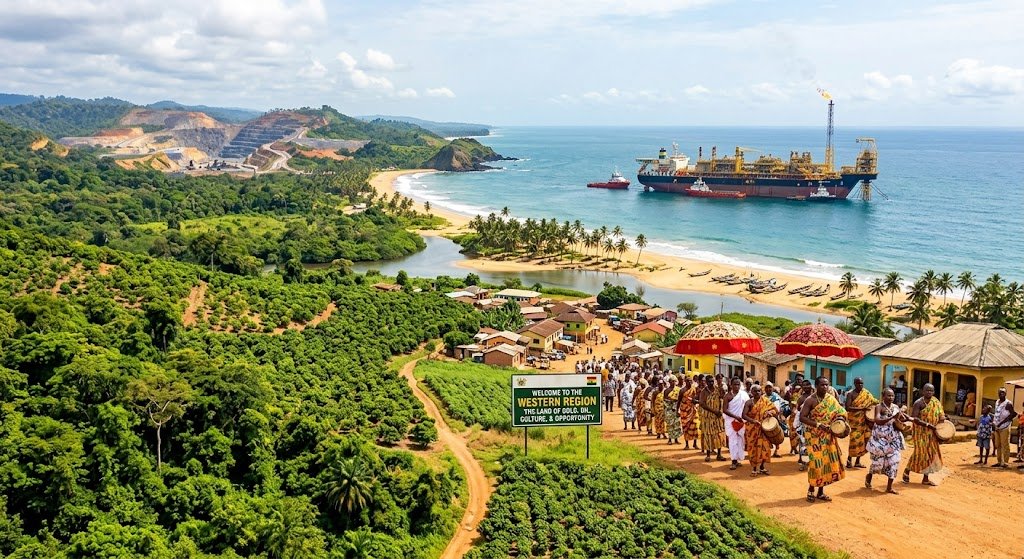
Perhaps the most famous festival in the region is the Kundum Festival, celebrated by the Ahanta and Nzema peoples. Kundum is a harvest festival that honors ancestors, gives thanks for agricultural abundance, and promotes community solidarity. The festival is marked by drumming, dancing, traditional processions, and elaborate displays of indigenous culture.
The Wassa people celebrate the Eddie Festival, another important harvest festival that commemorates successful farming seasons and gives thanks for prosperity. The festival provides an opportunity for family reunions and community development activities.
Among the Sefwi and Aowin peoples, the annual Alluolie Festival occupies a special place. Often referred to as the Yam Festival, it celebrates the yam harvest and reinforces cultural traditions while strengthening social bonds among community members.
These festivals attract thousands of visitors each year and contribute significantly to cultural tourism in Ghana.
Economic Activities and Occupations
The Western Region is one of Ghana’s economic powerhouses. The region’s economy is supported by agriculture, fishing, mining, forestry, manufacturing, and the petroleum industry.
Agriculture remains a major source of employment. Farmers cultivate cocoa, oil palm, rubber, coconut, cassava, maize, plantain, and other food crops. The fertile soils and favorable rainfall patterns make the region one of the country’s leading agricultural producers.
Fishing is another important occupation, particularly in coastal communities such as Axim, Dixcove, Shama, and Sekondi-Takoradi. Thousands of families depend on marine fishing, fish processing, and fish marketing for their livelihoods.
Mining has long been a cornerstone of the regional economy. The Western Region contains some of Ghana’s richest mineral deposits and hosts major mining towns such as Tarkwa, Prestea, Bogoso, and Damang. Gold mining, in particular, has played a central role in the economic development of the region for over a century.
In recent years, the discovery of offshore petroleum reserves has transformed the region into Ghana’s energy hub. The oil and gas industry has attracted significant domestic and foreign investment, creating employment opportunities and stimulating infrastructure development.
Educational Institutions
The Western Region has made important contributions to higher education and technical training in Ghana.
One of the region’s premier institutions is the University of Mines and Technology (UMaT) in Tarkwa. UMaT is internationally recognized for training professionals in mining, engineering, geology, and related fields. The university plays a vital role in supporting Ghana’s extractive industries.
Another major institution is Takoradi Technical University, which provides technical and vocational education in engineering, business, applied sciences, and technology. The university contributes significantly to workforce development and industrial growth.
The region is also home to several prestigious senior high schools, including Ghana Secondary Technical School (GSTS), Sekondi College, Archbishop Porter Girls’ Senior High School, Ahantaman Girls’ Senior High School, St. John’s School, and Fijai Senior High School.
Natural Resources: The Region’s Greatest Asset
The Western Region is arguably the most resource-rich region in Ghana.
Its mineral wealth includes gold, manganese, diamonds, and bauxite. Gold mining remains one of the region’s most important economic activities and has earned the area international recognition.
The region’s forests contain valuable timber species such as mahogany, odum, and wawa. These forests support Ghana’s timber industry and contribute significantly to export earnings.
The agricultural sector benefits from extensive cultivation of cocoa, rubber, coconut, and oil palm. These crops provide employment for thousands of households and contribute substantially to national revenue.
Perhaps the most transformative resource discovered in recent decades is petroleum. The offshore Jubilee Oil Field and related petroleum reserves have positioned the Western Region at the center of Ghana’s energy sector and future economic development.
Distinguished Sons and Daughters of the Western Region
The Western Region has produced numerous prominent Ghanaians whose contributions have left an enduring mark on the nation.
The most celebrated son of the region is Kwame Nkrumah, who hailed from Nkroful in Nzema. Nkrumah led Ghana to independence in 1957 and became the nation’s first Prime Minister and later its first President. His vision of Pan-Africanism continues to inspire people across Africa and the world.
Another distinguished figure is John Evans Atta Mills, who was born in Tarkwa. Mills served as President of Ghana from 2009 until his death in 2012 and was widely respected for his humility and commitment to democratic governance.
The Western Region also produced Anton Wilhelm Amo, one of Africa’s earliest internationally recognized scholars. Born near Axim in the eighteenth century, Amo became the first known African to earn a doctorate and teach at European universities.
Other notable personalities from the region include Joseph Boahen Aidoo, musician Kofi Kinaata, musician Gyedu-Blay Ambolley, actress Nadia Buari, and actor Boris Kodjoe.
Conclusion
The Western Region occupies a unique place in Ghana’s national story. It is a land blessed with immense natural resources, rich cultural traditions, thriving industries, and remarkable human talent. From its gold mines and oil fields to its forests, farms, beaches, and festivals, the region continues to make invaluable contributions to Ghana’s development.
As Ghana seeks sustainable economic growth and national transformation, the Western Region remains one of the country’s greatest assets—a region where history, culture, natural wealth, and human ingenuity come together to create boundless opportunities for future generations.