The Institution of Chop Money
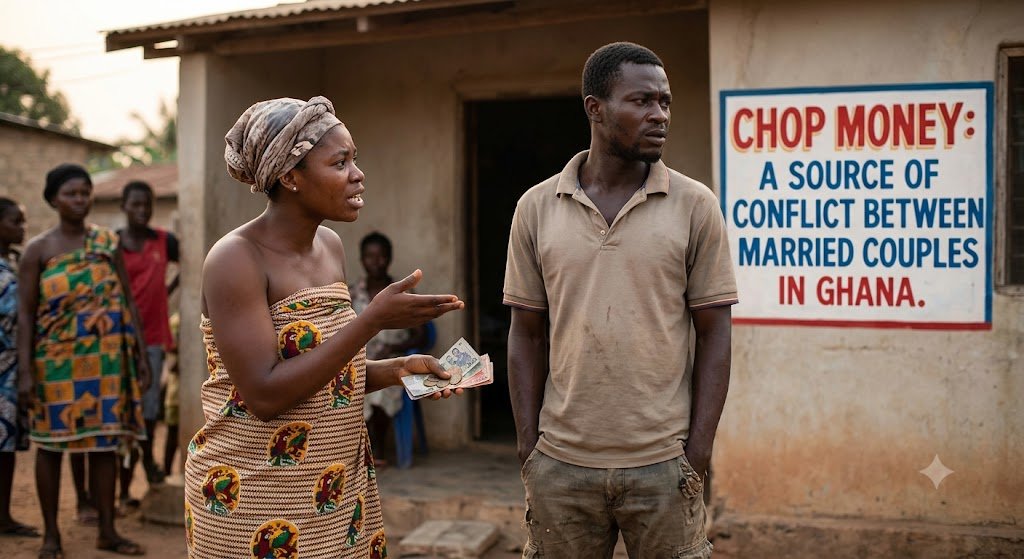
Chop money is oftentimes a source of conflict between Ghanaian husbands and their wives. Some of such conflicts result in verbal assaults, verbal disagreements, physical assaults, and occasionally death (uxoricide).
In Ghana, when a man marries a woman, it is his responsibility to provide her with "chop money."
Chop money is the amount of money a man gives to his wife for household food expenses. Some men also include money for the purchase of provisions such as soap, pomade, toothpaste, detergents, and other household necessities.
The institution of chop money has deep roots in traditional Ghanaian society. Historically, men were regarded as the principal providers for their families, while women were expected to prepare meals and manage the household. The provision of chop money became one of the most visible ways through which a husband demonstrated his commitment to his marital responsibilities. Although social and economic conditions have changed over time, the expectation that a husband should provide chop money remains deeply embedded in many Ghanaian marriages.
How Chop Money Is Provided
Chop money is often given daily, but some men enter into an arrangement to provide it weekly or monthly. The frequency and amount vary according to the husband's income, the size of the family, and the cost of living in a particular locality.
A man is expected to give chop money even if the wife earns more money than he does. In many households, the wife's income is viewed as supplementary rather than as a substitute for the husband's financial obligations. Consequently, a husband's responsibility to provide chop money remains largely unchanged regardless of his wife's earnings.
Chop Money and Masculine Identity
The provision of chop money is closely linked to notions of masculinity and male identity in Ghanaian society. A man who is unable to provide chop money loses face in the eyes of his wife and family. It is also a source of shame when members of the community learn about his inability to provide his wife with chop money or to provide an amount deemed adequate.
Many Ghanaian men derive a sense of pride and self-worth from their ability to provide for their families. Conversely, economic hardship, unemployment, underemployment, and rising living costs can make it difficult for men to fulfill this obligation. When a man is unable to provide adequate chop money, he may experience feelings of embarrassment, inadequacy, frustration, and loss of status.
Disputes Over the Amount
Arguments over chop money often center on the amount provided. If the wife believes the amount is insufficient, she communicates her concerns to her husband. If the husband does not respond by increasing the amount, conflict may develop between the couple.
The issue is often compounded by inflation and the rising cost of food and household necessities. What may have been considered an adequate amount several years ago may no longer be sufficient to feed a family today. As food prices rise, wives may find it increasingly difficult to stretch household resources, leading them to request additional funds from their husbands.
The Wife's Perspective
From the wife's perspective, managing the household can be a challenging responsibility. Women are often expected to purchase food, prepare meals, care for children, and ensure the smooth functioning of the household. When chop money is inadequate, wives may bear the burden of finding ways to make ends meet.
Some women supplement household expenses with income from petty trading, farming, or salaried employment. Others may receive assistance from relatives. Nevertheless, many wives view the provision of adequate chop money as a husband's fundamental obligation and may become resentful when they believe that obligation is not being fulfilled.
Suspicions About the Use of Chop Money
Sometimes, husbands initiate disputes over chop money when they believe that their wives are not purchasing food and household provisions commensurate with the amount provided. Some husbands suspect that their wives use part of the chop money to purchase personal items such as clothing, jewelry, cosmetics, and other non-household goods.
These suspicions can create mistrust within the marriage. Husbands may question how household funds are being spent, while wives may feel that their integrity and household management skills are being unfairly challenged. Such disagreements can become recurring sources of tension between spouses.
Changing Economic Realities
Contemporary Ghanaian society is undergoing significant social and economic changes. Increasing numbers of women are entering the workforce and contributing substantially to household income. As a result, some couples have adopted more collaborative approaches to managing household finances.
Nevertheless, traditional expectations often persist alongside modern realities. Even in households where wives contribute significantly to family income, many people continue to expect husbands to provide chop money. This coexistence of traditional gender expectations and modern economic arrangements can sometimes create confusion and conflict regarding financial responsibilities within marriage.
When Financial Disputes Turn Violent
Financial disagreements are among the most common sources of marital conflict. In some instances, disputes over chop money escalate beyond verbal arguments to physical confrontations. Economic stress, frustration, alcohol use, and unresolved marital tensions can contribute to the escalation of these conflicts.
Newspaper reports in Ghana occasionally document cases in which disputes over household finances, including chop money, have resulted in serious injuries or death. Such incidents underscore the importance of communication, compromise, and effective conflict resolution within marriage.
Conclusion
Chop money is more than a simple household allowance. It is a cultural institution that reflects broader ideas about marriage, gender roles, masculinity, family responsibilities, and economic provision in Ghanaian society. While it serves an important function in organizing household finances, it can also become a source of tension and conflict when expectations differ or when economic circumstances make adequate provision difficult.
As Ghanaian society continues to change, couples are increasingly required to negotiate the meaning and practice of chop money within the context of contemporary economic realities. Understanding the cultural significance of chop money can provide valuable insight into the dynamics of marriage and family life in Ghana.