Introduction
Among Ghana’s sixteen administrative regions, few possess the historical significance, educational prominence, and cultural richness of the Central Region. Located along Ghana’s southern coastline, the region occupies a unique place in the nation’s history. It was one of the earliest areas of contact between Africans and Europeans, the birthplace of some of Ghana’s foremost nationalists and intellectuals, and the home of prestigious educational institutions that have shaped generations of leaders.
The Central Region is often referred to as the “Cradle of Education in Ghana,” but its contributions extend far beyond the classroom. The region has played a central role in politics, commerce, tourism, culture, religion, and nation-building. Its castles and forts bear witness to the trans-Atlantic slave trade, while its schools and universities continue to produce leaders who influence Ghana and the wider world.
Location and Physical Features
The Central Region is located along the southern coast of Ghana. It is bounded by the Western Region to the west, the Ashanti and Eastern Regions to the north, the Greater Accra Region to the east, and the Gulf of Guinea to the south. The regional capital is Cape Coast, a historic city that once served as the capital of the Gold Coast during the colonial era.
The region covers approximately 9,826 square kilometers and consists of coastal plains, forests, rivers, lagoons, and fertile agricultural lands. Numerous fishing communities dot the coastline, while inland areas support farming and commercial activities. The region’s strategic coastal location helped make it one of the most important centers of trade and administration during both the pre-colonial and colonial periods.
Population and Ethnic Composition
According to Ghana’s 2021 Population and Housing Census, the Central Region has a population of approximately 2.86 million people. The region is one of the most densely populated areas in Ghana and continues to experience significant urban growth.
The largest ethnic group in the region is the Fante, an Akan-speaking people whose influence extends throughout Ghana’s political, educational, and commercial sectors. Other important ethnic groups include the Agona, Assin, Twifo, Denkyira, and the Guan-speaking Efutu and Awutu peoples.
The Fante language serves as the principal language spoken throughout much of the region, although English is widely used in schools, government institutions, and business settings.
Rich Cultural Heritage and Festivals
The Central Region possesses a vibrant cultural heritage that is reflected in its traditional festivals, customs, and institutions.
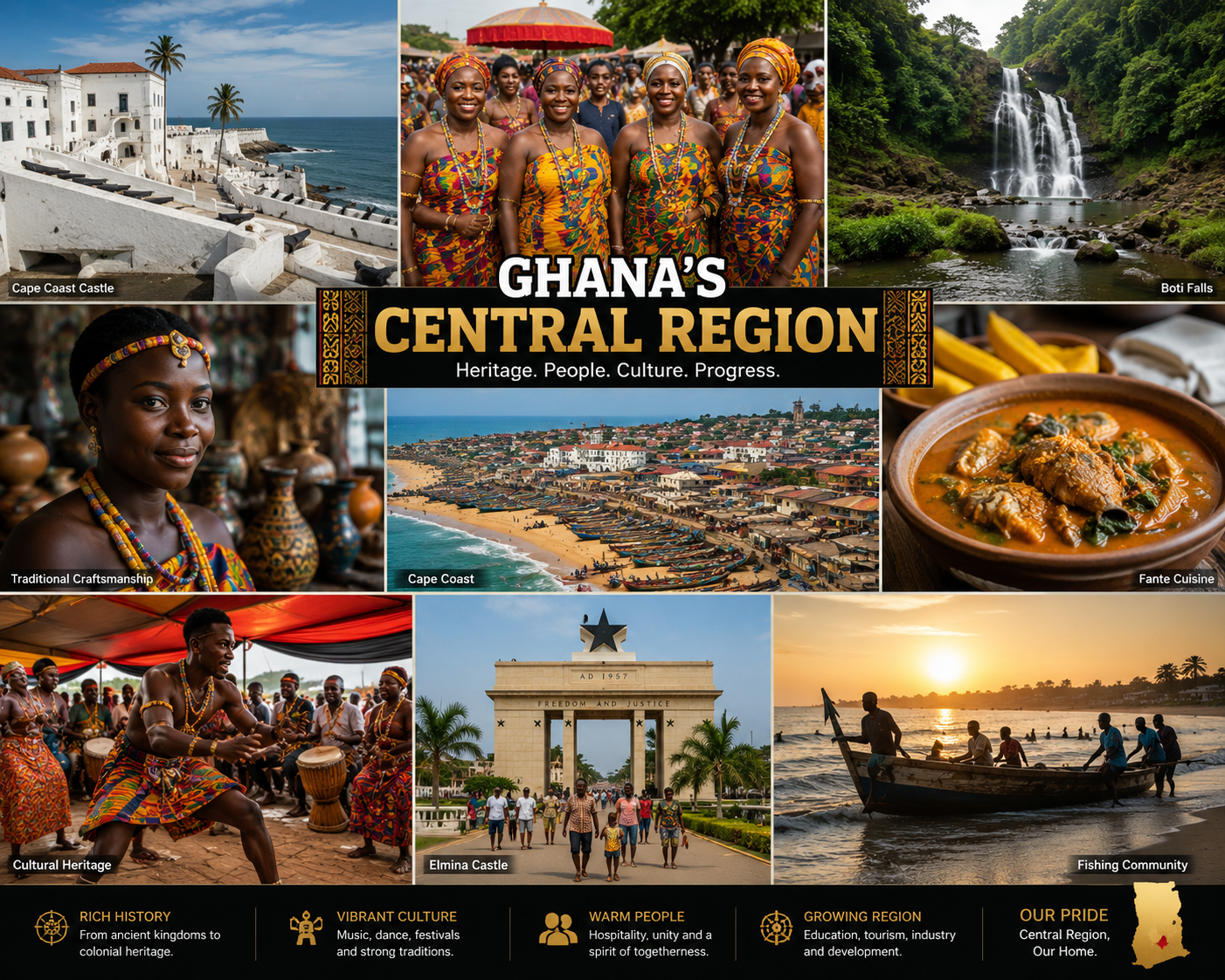
One of the most celebrated festivals is the Fetu Afahye Festival of Cape Coast. This annual event is a purification and thanksgiving ceremony that attracts thousands of visitors from across Ghana and abroad. The festival showcases traditional music, dancing, colorful durbars, and the rich cultural traditions of the Fante people.
Another famous festival is the Aboakyer Festival of Winneba. During this unique celebration, members of rival Asafo companies compete to capture a live deer, which is presented to the traditional authorities as part of the festivities. The festival commemorates the migration history of the Efutu people and is one of Ghana’s most distinctive cultural events.
The Odambea Festival celebrated by the people of Nkusukum and the Akwambo Festival celebrated by the Agona people are equally important cultural occasions. These festivals reinforce communal identity, preserve history, and promote social cohesion.
Together, these celebrations serve as important reminders of the region’s rich cultural heritage and enduring traditions.
Economic Activities and Occupations
The Central Region enjoys a diversified economy based on fishing, agriculture, tourism, trade, education, and services.
Fishing remains one of the most important occupations along the coast. Communities such as Elmina, Moree, Apam, Winneba, Mumford, and Saltpond have depended on fishing for generations. The fishing industry provides employment for fishermen, fish processors, fish traders, boat builders, and transport operators.
Agriculture is another major source of livelihood. Farmers cultivate cocoa, oil palm, coconut, citrus fruits, cassava, maize, plantain, and vegetables. Cocoa production remains particularly important in the Assin, Twifo, and Denkyira areas.
The region’s tourism industry is among the most developed in Ghana. Visitors from around the world travel to Cape Coast Castle, Elmina Castle, Kakum National Park, and other historical and ecological attractions. Tourism generates employment in hotels, restaurants, transportation, handicrafts, and tour services.
Education has also become a significant economic activity. The presence of major universities and secondary schools attracts thousands of students, lecturers, researchers, and support personnel, contributing substantially to local economic development.
The Cradle of Education in Ghana
No discussion of the Central Region would be complete without highlighting its unparalleled contribution to education.
For more than a century, Cape Coast has been regarded as the educational capital of Ghana. Many of the nation’s oldest and most prestigious schools are located within the region.
Among these institutions are Mfantsipim School, Adisadel College, Wesley Girls’ High School, St. Augustine’s College, Holy Child School, Mfantsiman Girls’ Senior High School, and Aggrey Memorial A.M.E. Zion Senior High School. These schools have educated numerous presidents, ministers, judges, academics, diplomats, and business leaders.
The region is also home to three major tertiary institutions: the University of Cape Coast, the University of Education, Winneba, and Cape Coast Technical University. These institutions attract students from throughout Ghana and many other countries.
Because of its long tradition of academic excellence, the Central Region has rightly earned the title of Ghana’s educational heartland.
Natural Resources and Tourism Assets
The Central Region is endowed with a variety of natural resources that contribute significantly to national development.
Mineral deposits found in the region include gold, diamonds, bauxite, kaolin, granite, feldspar, quartz, tantalite, and clay. Gold mining has been especially important in parts of the Denkyira area.
The region also possesses extensive forest resources that support timber production and environmental conservation.
Historically, the Saltpond Oil Field represented Ghana’s first commercial oil-producing venture, making the region an important part of the country’s petroleum history.
Perhaps the region’s most visible resource, however, is its tourism potential. Cape Coast Castle and Elmina Castle are UNESCO World Heritage Sites and stand as powerful reminders of the trans-Atlantic slave trade. Thousands of members of the African diaspora visit these sites each year in search of historical understanding and cultural reconnection.
Kakum National Park, famous for its canopy walkway suspended above the rainforest, is one of the most visited tourist destinations in West Africa. The region’s beaches, lagoons, and cultural festivals further enhance its appeal as a major tourism destination.
Distinguished Sons and Daughters of the Central Region
The Central Region has produced an extraordinary number of distinguished Ghanaians whose contributions have shaped national and international affairs.
One of the most famous is Kofi Annan of Ekumfi Otuam. Annan served as Secretary-General of the United Nations from 1997 to 2006 and was awarded the Nobel Peace Prize in 2001. Throughout Ghana, he is widely recognized as a proud son of the Central Region and one of the most respected diplomats in world history.
Another distinguished son of the region was Professor John Evans Atta Mills, Ghana’s third President under the Fourth Republic. Born in Tarkwa but raised within the Fante cultural tradition, Mills was widely admired for his humility, integrity, and commitment to democratic governance.
The Central Region also produced Dr. James Emman Kwegyir Aggrey, one of Africa’s greatest educators and advocates for racial equality. His contributions to education continue to influence generations of Africans.
Other notable figures associated with the region include John Mensah Sarbah, J. E. Casely Hayford, Kobina Sekyi, Kwesi Bekoe Amissah-Arthur, Paa Kwesi Nduom, Michael Essien, John Mensah, and numerous judges, academics, clergy, military officers, and business leaders.
The region’s contribution to national leadership has been both profound and enduring.
The Historical Importance of the Central Region
The Central Region occupies a unique place in Ghana’s history. It served as an important center of trade long before European arrival. During the colonial era, it became a major administrative and educational hub. Many of the earliest nationalist movements emerged from the region, and several of Ghana’s leading independence advocates hailed from its towns and villages.
The region’s castles and forts remind us of painful chapters in African history, while its schools and universities symbolize hope, progress, and national development. It is a region where history, culture, education, and economic enterprise intersect in remarkable ways.
Conclusion
The Central Region stands as one of Ghana’s greatest treasures. Its rich cultural traditions, vibrant festivals, distinguished educational institutions, valuable natural resources, thriving economic activities, and outstanding citizens have made it indispensable to Ghana’s development.
From the classrooms of Mfantsipim and Wesley Girls to the halls of the United Nations where Kofi Annan once served; from the historic walls of Cape Coast Castle to the canopy walkways of Kakum National Park, the Central Region continues to inspire pride, achievement, and national unity.
As Ghana moves forward in the twenty-first century, the Central Region remains a shining example of how history, culture, education, and leadership can combine to build a stronger and more prosperous nation.