Understanding One of Ghana’s Most Enduring Social Questions
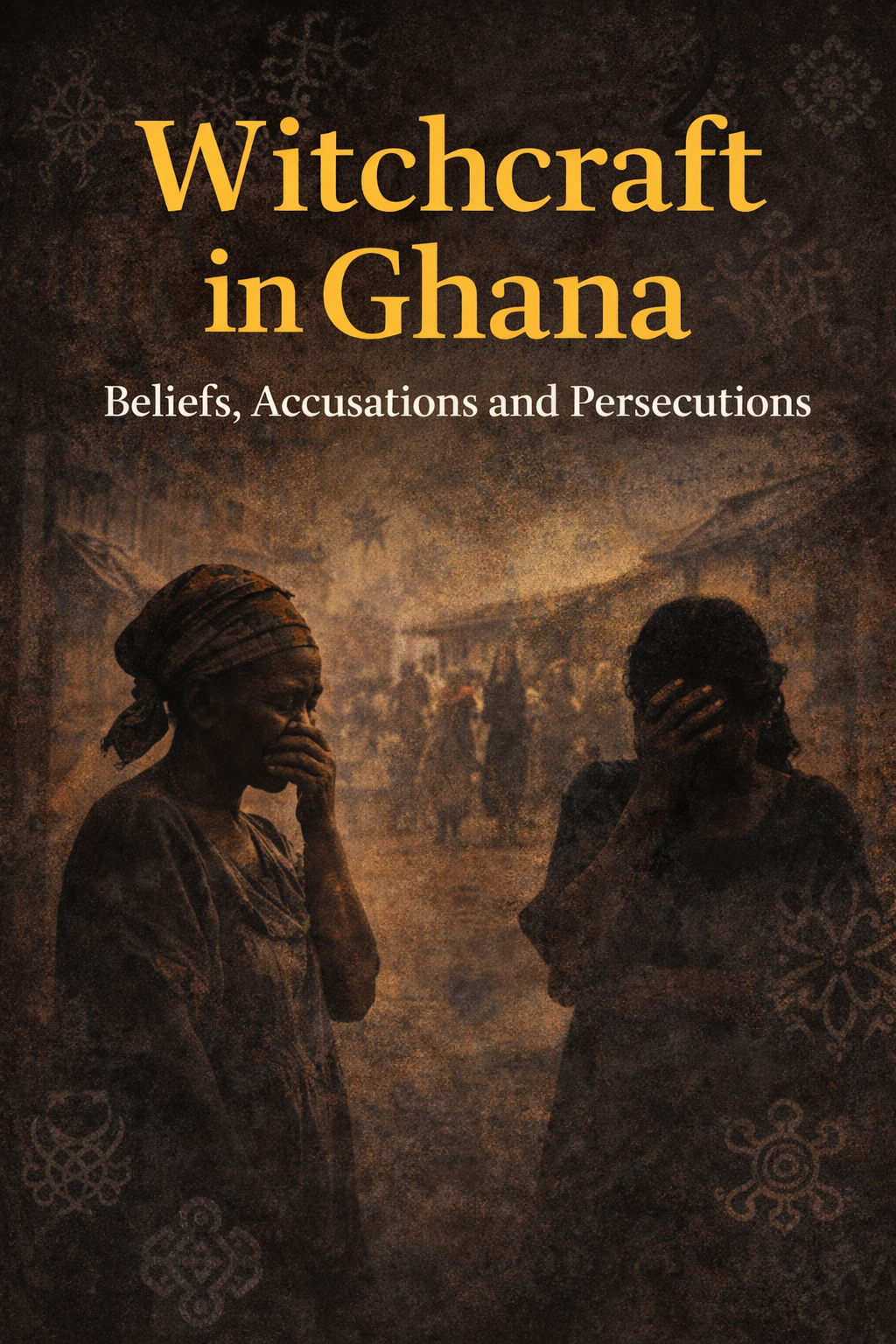
Research on witchcraft in Ghana spans nearly a century and reflects the country’s continuing struggle to understand belief, accusation, fear, violence, and spirituality. Over the decades, scholars, religious leaders, NGOs, and criminologists have all attempted to explain why witchcraft accusations persist and how such beliefs shape everyday life.
From early ethnographic studies to contemporary analyses of gender violence, witchcraft research in Ghana has grown into a rich and important field of inquiry. Yet, despite the volume of work produced, major gaps remain in our understanding of witchcraft beliefs, witch-hunting, and the experiences of accused persons.
The Early Foundations of Witchcraft Research
One of the earliest systematic studies of witchcraft in Ghana was undertaken by Hans Debrunner. His influential 1961 book, Witchcraft in Ghana, documented beliefs, practices, accusations, and rituals among several ethnic groups. Debrunner situated witchcraft within local moral systems and social relations, showing how accusations were often linked to tensions within families and communities.
Even before Debrunner, anthropologist Margaret Field had explored witchcraft beliefs among the Ga people. In Chapter Four of her 1937 classic, Religion and Medicine of the Ga People, she examined the relationship between illness, religion, and occult beliefs. Her later work, Search for Security, expanded the discussion among the Akan and explored how misfortune, sickness, and social instability were frequently interpreted through spiritual and supernatural explanations.
Another important contribution came from Bannerman’s 1982 publication, The Practice of Witchcraft in Ghana, which catalogued ritual techniques, accusation patterns, and local explanatory models associated with witchcraft beliefs.
These early studies laid the intellectual foundation for later generations of researchers by documenting the central place of witchcraft beliefs in Ghanaian society.
A Shift Toward Violence and Human Rights
Beginning in the early 2000s, research on witchcraft in Ghana increasingly shifted toward issues of violence, victimization, and human rights.
Professor Mensah Adinkrah emerged as one of the leading scholars in this area. In 2004, he published the article “Witchcraft Accusations and Female Homicide Victimization,” which examined cases in which women accused of witchcraft became victims of lethal violence. His later studies explored child witchcraft accusations, vigilante violence, and the social consequences of witch-hunting.
His 2015 book, Witchcraft, Witches and Violence in Ghana, remains one of the most comprehensive modern studies on the subject. The work combines ethnography, criminology, sociology, and social analysis to examine persecution, violence, fear, and the broader cultural dynamics surrounding witchcraft accusations.
This newer body of research helped shift public attention from witchcraft merely as belief to witchcraft as a serious social and human rights issue.
Research on Witch Camps and Northern Ghana
A significant portion of contemporary research has focused on the famous witch camps of northern Ghana.
Several doctoral dissertations and academic studies have examined witchcraft beliefs among groups such as the Gonja, Mamprusi, and Konkomba.
Substantial work on Ghana’s witch camps and witch camp residents has also been conducted by Dr. Leo Igwe, Dr. Mutaru Saibu, and Dr. Issah Wumbla. Their PhD dissertations examined important aspects of witch camps in northern Ghana, while some of their additional studies have appeared in peer-reviewed academic journals. Their contributions have helped deepen scholarly understanding of the social realities, human rights dimensions, and lived experiences associated with witchcraft accusations and exile settlements. NGO reports have also played a major role in documenting the realities of accused persons.
Publications such as The Wasted Years and Condemned Without Trial presented interviews with women living in witch camps and revealed the pain, exile, fear, and social rejection experienced by many accused individuals.
In 2023, Mabefam published Witch Camps and Witchcraft Discourse in Africa, a revised version of his doctoral dissertation. The book explored not only the social dynamics within witch camps but also the wider discourse surrounding witchcraft accusations in Ghana and across Africa.
The Religious Dimension of Witchcraft Research
Religious publications have also shaped public understanding of witchcraft in Ghana.
Christian-oriented authors often interpret witchcraft through Biblical teachings and Pentecostal-charismatic ideas about spiritual warfare, demonic activity, and deliverance.
Among the notable works are Noble Simpson’s Unravelling the Mystery of Witchcraft and Rev. Francis J. Botchway’s Juju, Magic and Witchcraft in African Soccer: Myth or Reality. These books emphasize prayer, exorcism, deliverance, and the authority of pastors over traditional spiritual practitioners.
In many churches today, witchcraft is not merely treated as folklore or superstition but as a present spiritual reality requiring active intervention through prayer and deliverance.
The Major Questions That Remain Unanswered
Despite nearly a century of research, many important questions remain unanswered.
One major puzzle is the underrepresentation of men among accused witches. Across Ghanaian cosmologies, both men and women are believed capable of witchcraft. Yet women overwhelmingly constitute the majority of accused persons, especially in northern Ghana.
Another poorly understood issue is the dominance of men among accusers and participants in vigilante-style witch hunts. Researchers have not adequately explained why women are rarely involved in the physical enforcement of witchcraft accusations.
There are also important legal questions that remain largely unexplored. Very little research has examined what happens to individuals prosecuted for witch-hunting, whether imprisonment serves as a deterrent, or why witch hunts continue despite state sanctions.
Similarly, the long-term consequences of closing witch camps in northern Ghana have not been rigorously studied. It remains unclear whether the closure of camps reduces accusations and violence or merely disperses the problem into surrounding communities.
The Hidden World of Prayer Camps
Another neglected area of research involves Christian prayer camps in southern Ghana.
In some of these camps, individuals accused of witchcraft undergo deliverance sessions, exorcisms, fasting, and spiritual treatment. Yet little scholarly attention has been paid to the experiences of accused persons within these institutions.
Researchers still know very little about how prayer camps influence accusation processes, social reintegration, family relationships, and perceptions of guilt or innocence.
This remains one of the least understood dimensions of contemporary witchcraft discourse in Ghana.
How Many Ghanaians Believe in Witchcraft?
Perhaps the greatest gap in existing research is the absence of nationally representative data on belief itself.
At present, Ghana lacks a comprehensive national survey examining who believes in witchcraft, how widespread such beliefs are, and whether belief is increasing or declining over time.
There is also little reliable data showing how belief varies according to age, gender, ethnicity, religion, education, or social class.
Without such information, policymakers, NGOs, educators, and religious organizations are left without the evidence needed to design informed interventions and educational programs.
The Need for a New Generation of Research
Witchcraft research in Ghana is rich in historical detail, ethnographic description, and case studies. However, much more work remains to be done.
Future research must move beyond isolated cases and address the broader structural, demographic, institutional, and long-term dimensions of witchcraft belief and accusation.
Understanding these dynamics is essential if Ghana is to develop evidence-based responses that address both the social realities and the spiritual meanings attached to witchcraft beliefs.
As the country modernizes and urbanizes, witchcraft accusations have not disappeared. Instead, they continue to evolve in new religious, social, and cultural settings. The challenge for scholars, policymakers, and community leaders is therefore not simply to dismiss these beliefs, but to understand their enduring power and their consequences for Ghanaian society.